Impacts of AI
I've described how the liberal market economy has a range of limitations and problems, but I haven't really discussed the specific problem that such an economy is not future-proofed. Innovation - which should be an unambiguously good thing - can be the driver for greater inefficiency and wealth inequality. This is an issue in general, but it is more apparently an issue in cases of radical change such as could occur with AI.
The prospect raised with AI is that it could perform the jobs of a wide range of workers in a more efficient or less costly manner, putting a significant percentage of the workforce out of jobs. From an exchange economy perspective, this is an issue because jobs are a critical component of how resources are allocated, and the alternatives - government intervention and spending or widespread poverty - are, by various parties and for various reasons, considered unacceptable. From the perspective of a giftmoot economy, a reduction in jobs is not necessarily a bad thing, and so innovation in AI does not pose a particularly serious issue.
The impacts of innovation
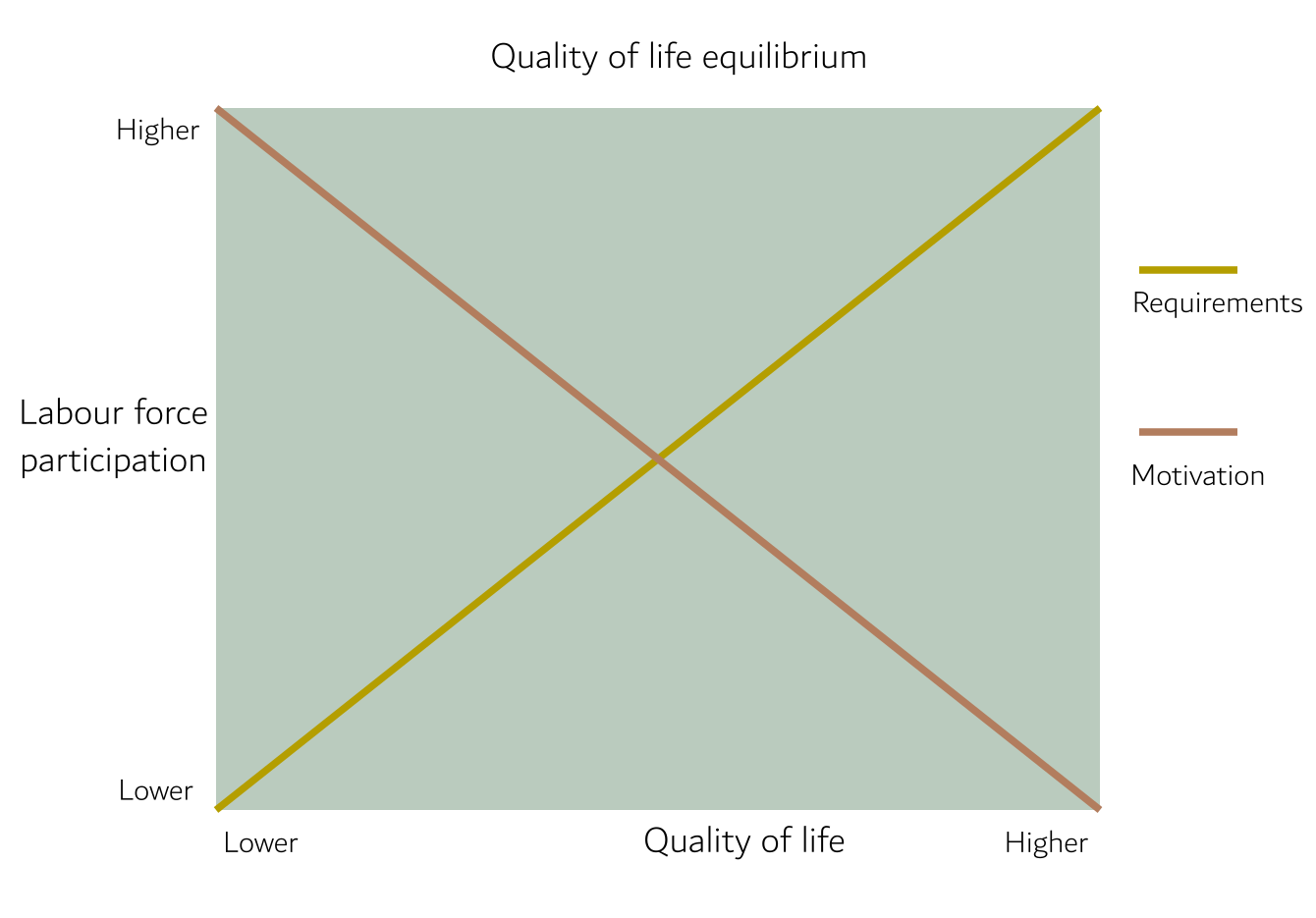
As a reminder, here is the graph that I proposed for a non-reciprocal gifting economy. The graph suggests that the more people who work, the greater the quality of life can be, and the greater the quality of life, the less people will want to work, until there is an equilibrium where the two trends intersect:
An innovation such as AI should reduce the amount of people who need to work to achieve any particular quality of life, changing where that equilibrium is:
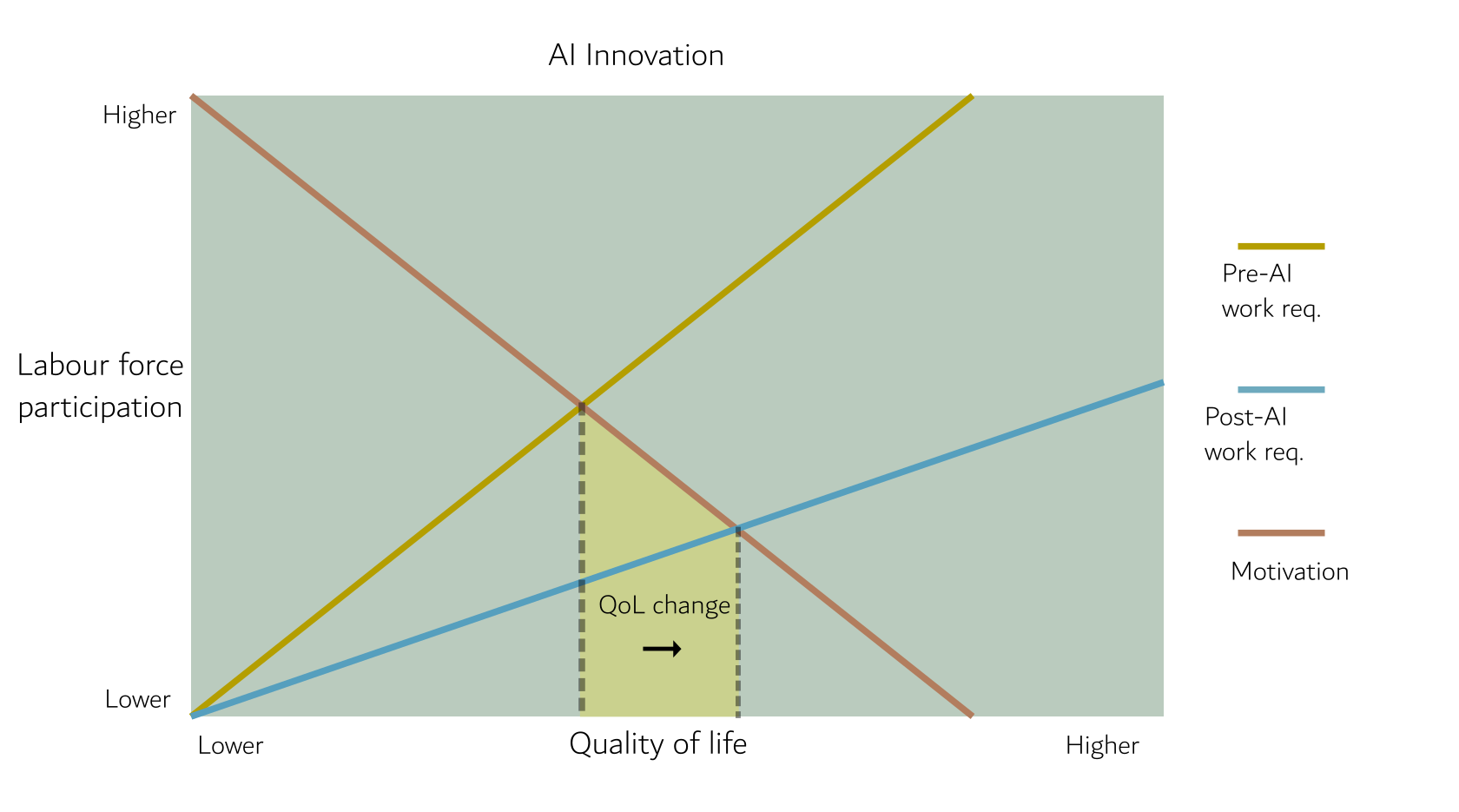
In this model, AI innovation decreases the number of workers and increases quality of life.
The impact of the exchange economy
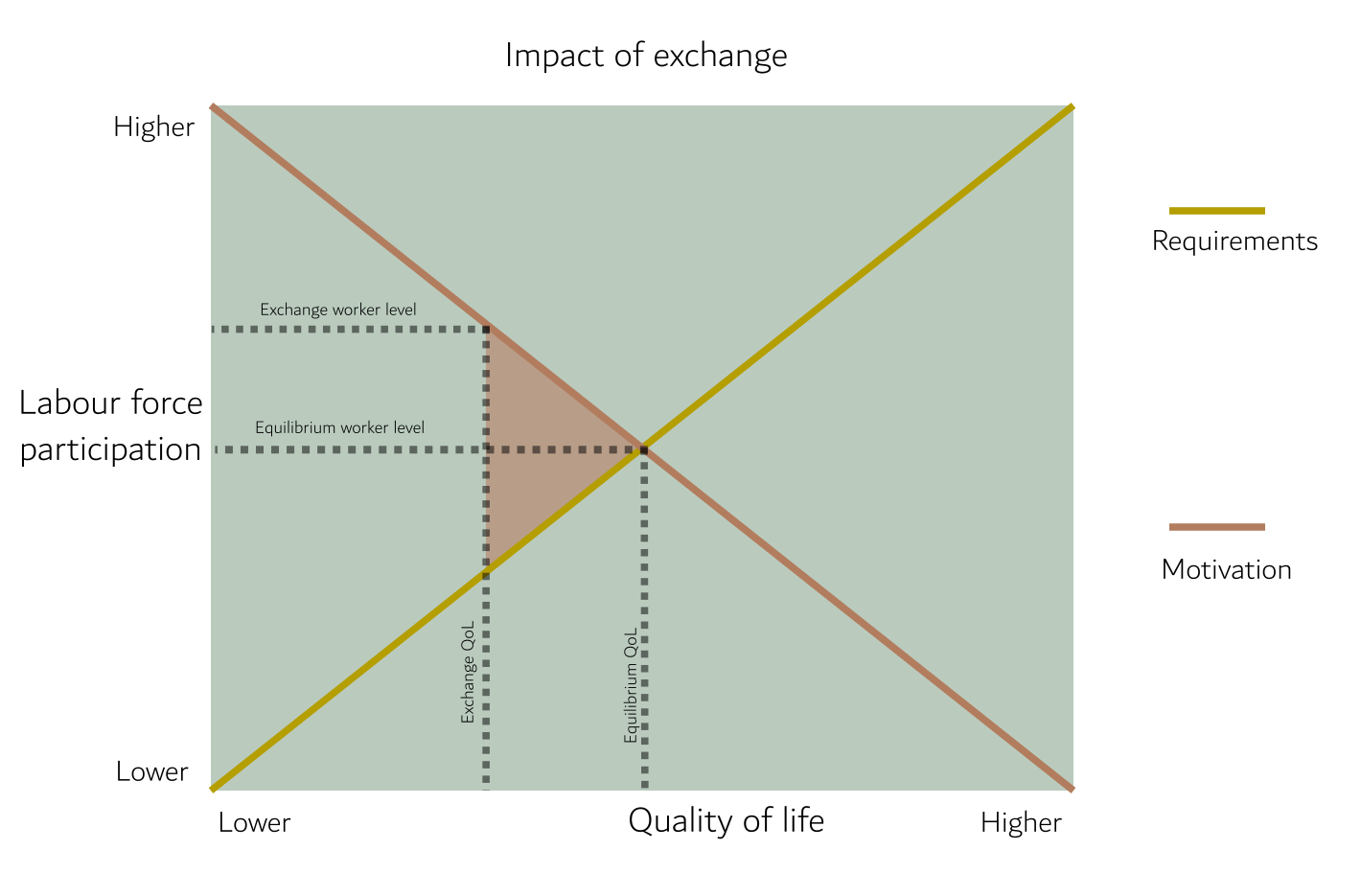
However, in an exchange economy, people need to work because if they don't, they won't receive the pay they need to survive. This means that there is a minimum number of workers that would be working at any time, regardless of the quality of life. People won't stop working when society achieves a comfortable quality of life for them, because they will still need to work to access that quality of life from the market.
This "excess" labour force participation constitutes "busy jobs":
These jobs represent an inefficiency, which means over-productivity without an increase in quality of life, and jobs that sustain the functions of an exchange economy (like financial, insurance, stock market, and contract arbitration and enforcement jobs). In fact, because these jobs don't increase the quality of life of the workers, either by performing the jobs or by producing things that directly improve their quality of life, there are perhaps two more proposals that can be tentatively made about them. The first is that many of them will be desperate jobs - jobs that people have to take because otherwise they would not have a job at all. Why would busy jobs in particular be desperate jobs? I think this largely because if they were genuinely productive jobs, people would be motivated to do them anyway, and so people are only motivated into these jobs because of the need to survive. The second is that many probably are productive and do improve quality of life, but not for society in general. Instead, they improve quality of life for an investor class who doesn't need to labour (or labour as much) in order to achieve their quality of life, even in a market system.
I'm going to represent this second part on the graph as the distance between the giftmoot economy equilibrium and the exchange economy equilibrium, and suggest that this distance represents two things: a loss of quality of life potential, and a factor that affects wealth inequality. That is, this distance indicates how much quality of life improvement we are missing out on because we have adopted an exchange economy, and how severe wealth inequality is likely to be, with a larger distance indicating it is more severe:
AI in an exchange economy
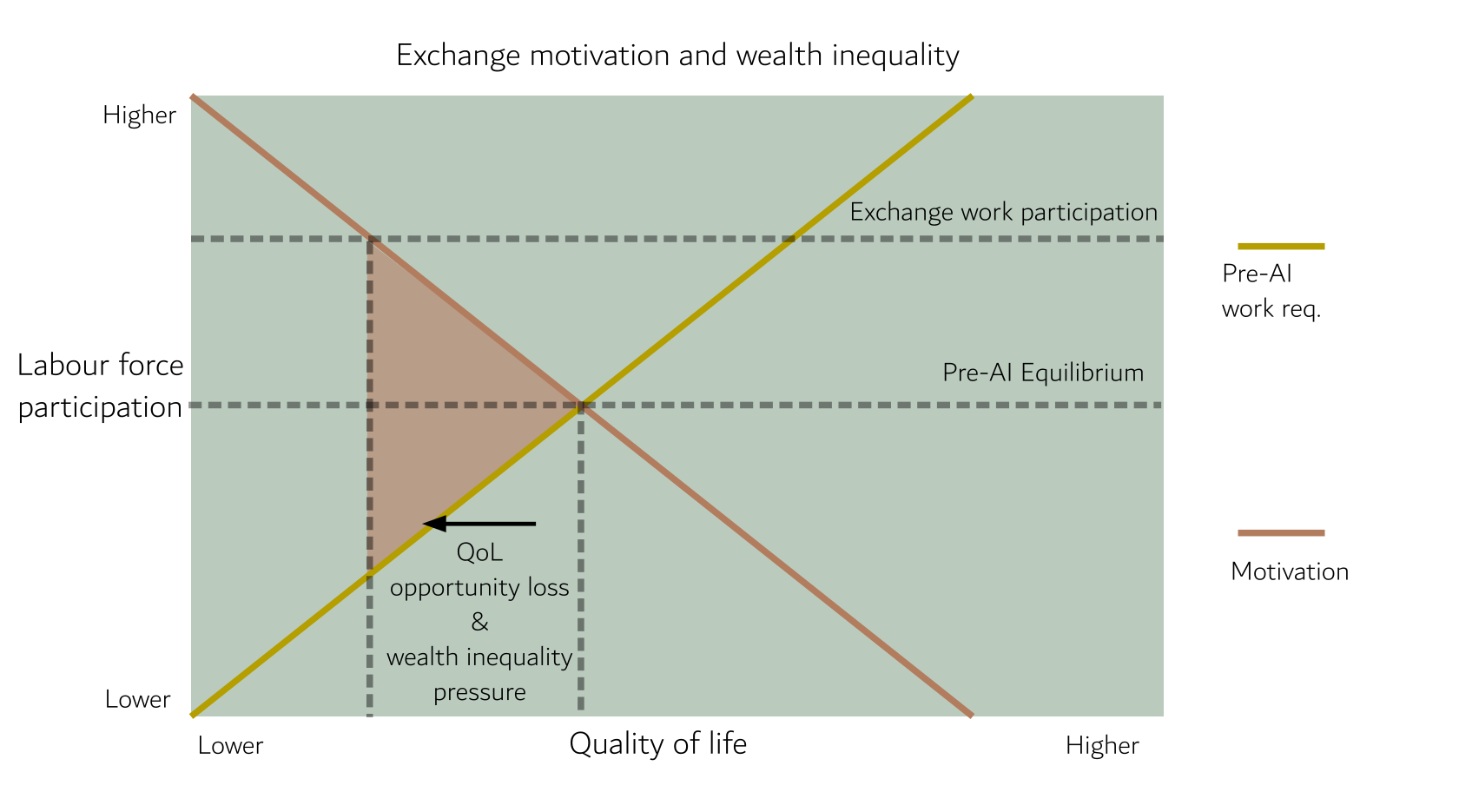
With that in mind, we have the graphs at the top indicating the equilibrium of a giftmoot economy, and the potential future equilibrium if the promise of AI reducing jobs comes to fruition, and I want to present a graph below that suggests what the economic future could look like if AI innovation occurs in an exchange economy:
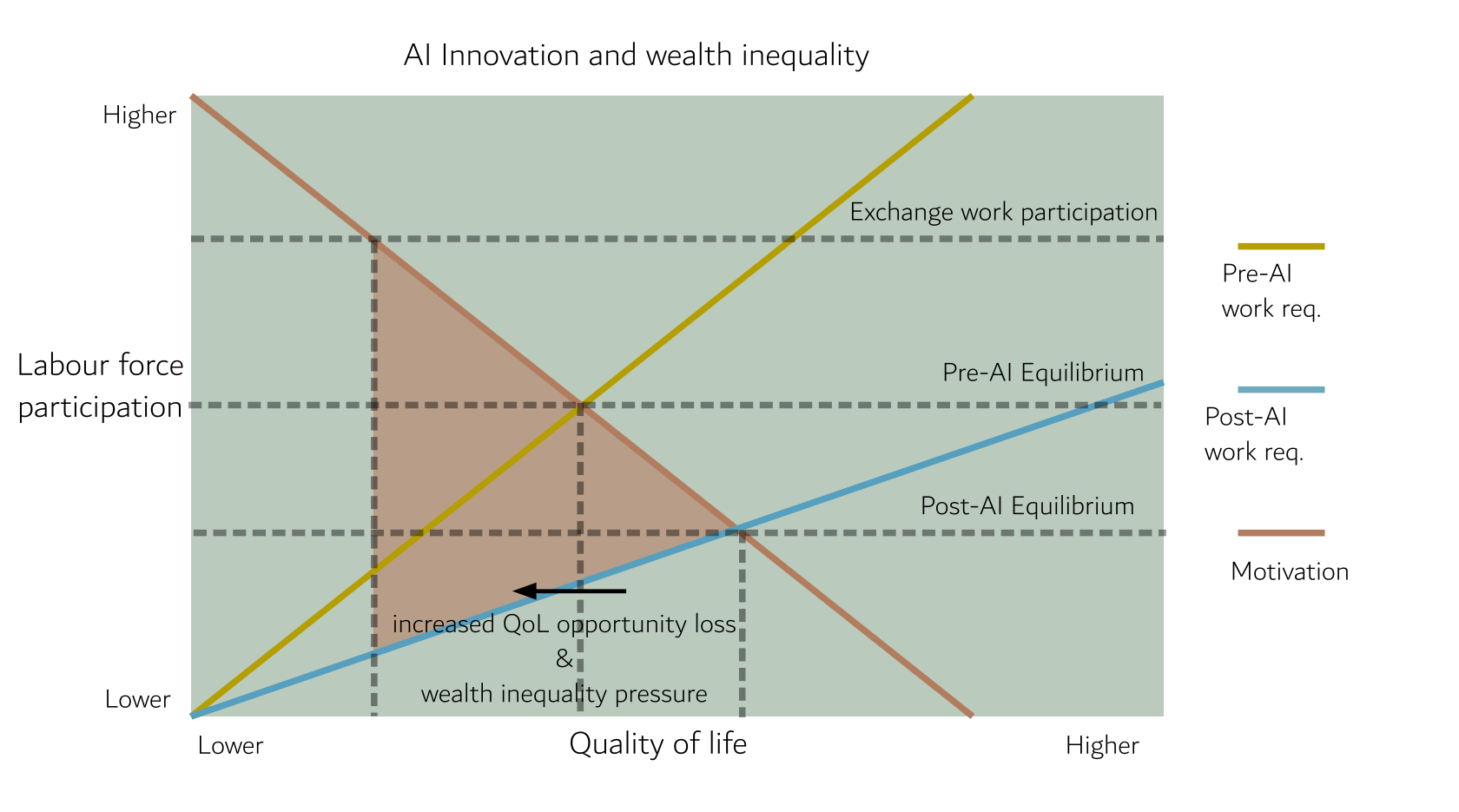
The story of this graph is that if AI innovation reduces the amount of jobs needed for any particular quality of life, and if the exchange economy still motivates a minimum amount of workers to work that is in excess of the giftmoot equilibrium, then there are two existing problems that will be greatly exacerbated. The first is that the gap between the exchange economy quality of life and the potential quality of life will have increased. This represents that AI innovations could genuinely improve the condition of the world for society but that the exchange economy could hold those improvements back. The second is that wealth inequality is likely to increase substantially. This represents that AI innovations will produce a better quality of life for the wealthy without the majority of society able to access this higher quality of life - and that the gap will grow.
The three options for the exchange economy are either more government intervention in welfare (such as a universal basic income), widespread poverty, or more busy jobs. This graph indicates the increase in busy jobs under these circumstances. The critical issue is that busy jobs are likely to be desperate jobs, creating not just wealth inequality but an exploitable underclass.
The point is that an exchange economy is just not equipped to undergo such a radical innovative change without some fundamental economic movement away from exchanges (such as widespread gifting in a universal basic income or a move to a non-reciprocal gifting economy), or an increase in poverty, exploitation and wealth inequality.