Comparison to an exchange economy
In terms of free riders and quality of life, does an exchange economy operate differently or in a relatively similar fashion to a non-reciprocal gifing economy?
The relationship between worker requirements and motivations in an exchange economy
First, let's imagine an exchange economy with a universal basic income, or UBI, that is an unconditional regular payment that everyone has access to. For our purposes we can set the amount at roughly any point, as long as it is fixed.
Now we line up our entire working population again by acceptable quality of life. Those people who have their quality of life met by the UBI will not work, and the rest will work to an amount based on how much they need to earn to meet their acceptable quality of life. We'll assume, as well, that every job is a productive job that increases the overall quality of life of the population - that is, by working one immediately increases their own quality of life (by getting more money than the UBI offers) and the quality of life in society in general (because their job is productive and useful).
We should end up with a graph roughly similar to the gifting economy graph:
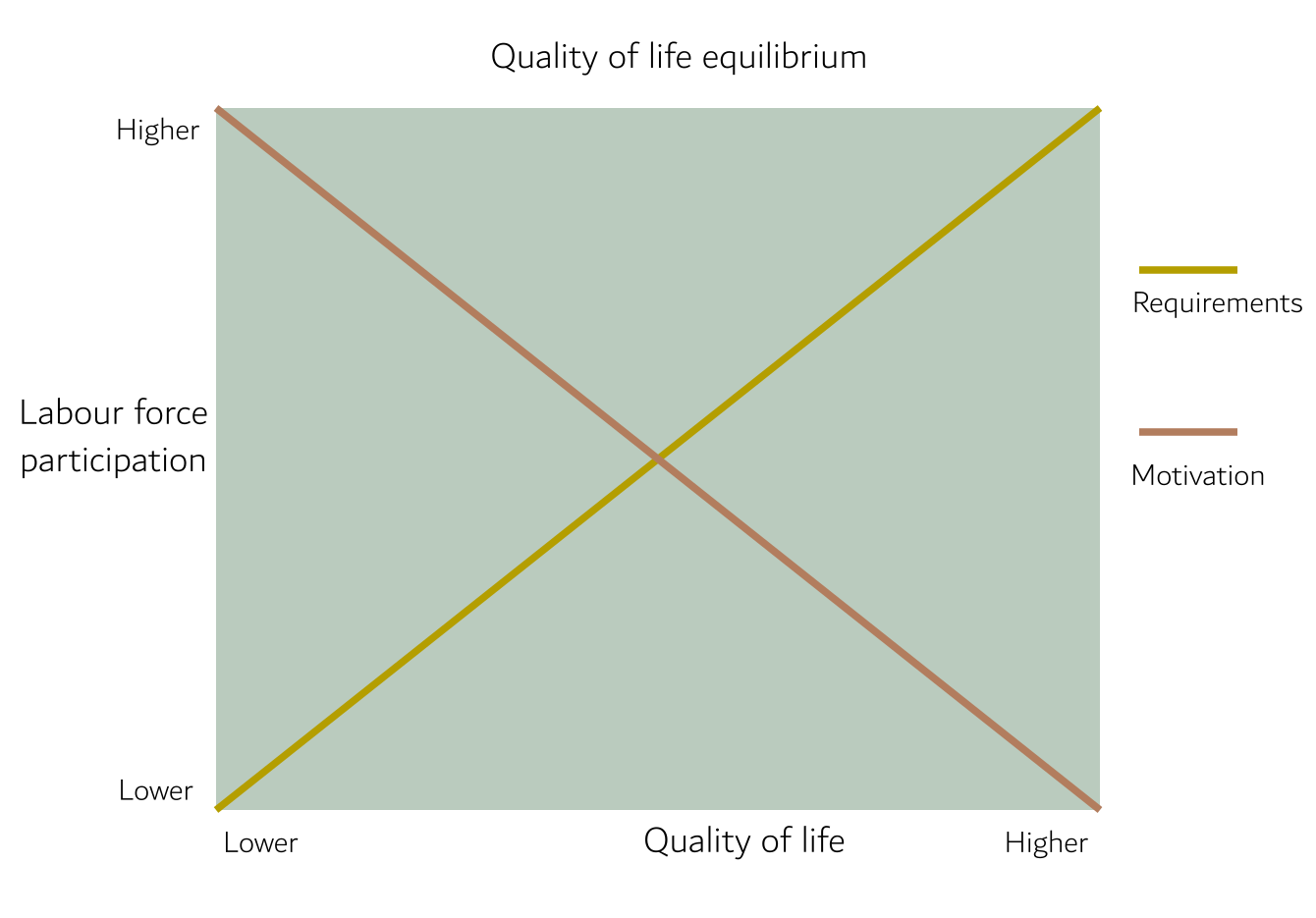
The line for the motivation of workers will vary depending on the amount of the UBI and how this relates to pricing and inflation and several other factors, but let's say that we've figured out a UBI that would match the motivation of our non-reciprocal gifting economy (whether that is totally realistic or not), and say that the equilibrium point is right in the centre of the chart.
What would cause that equilibrium point to move around? What would place it higher on the quality of life measure, in particular? The two things we have to play around with are the number of jobs required to reach a certain quality of life, and the second is the amount of people who can free ride at an acceptable quality of life.
Let's start with the number of jobs required to reach a particular quality of life. We've already seen that innovation can improve this:
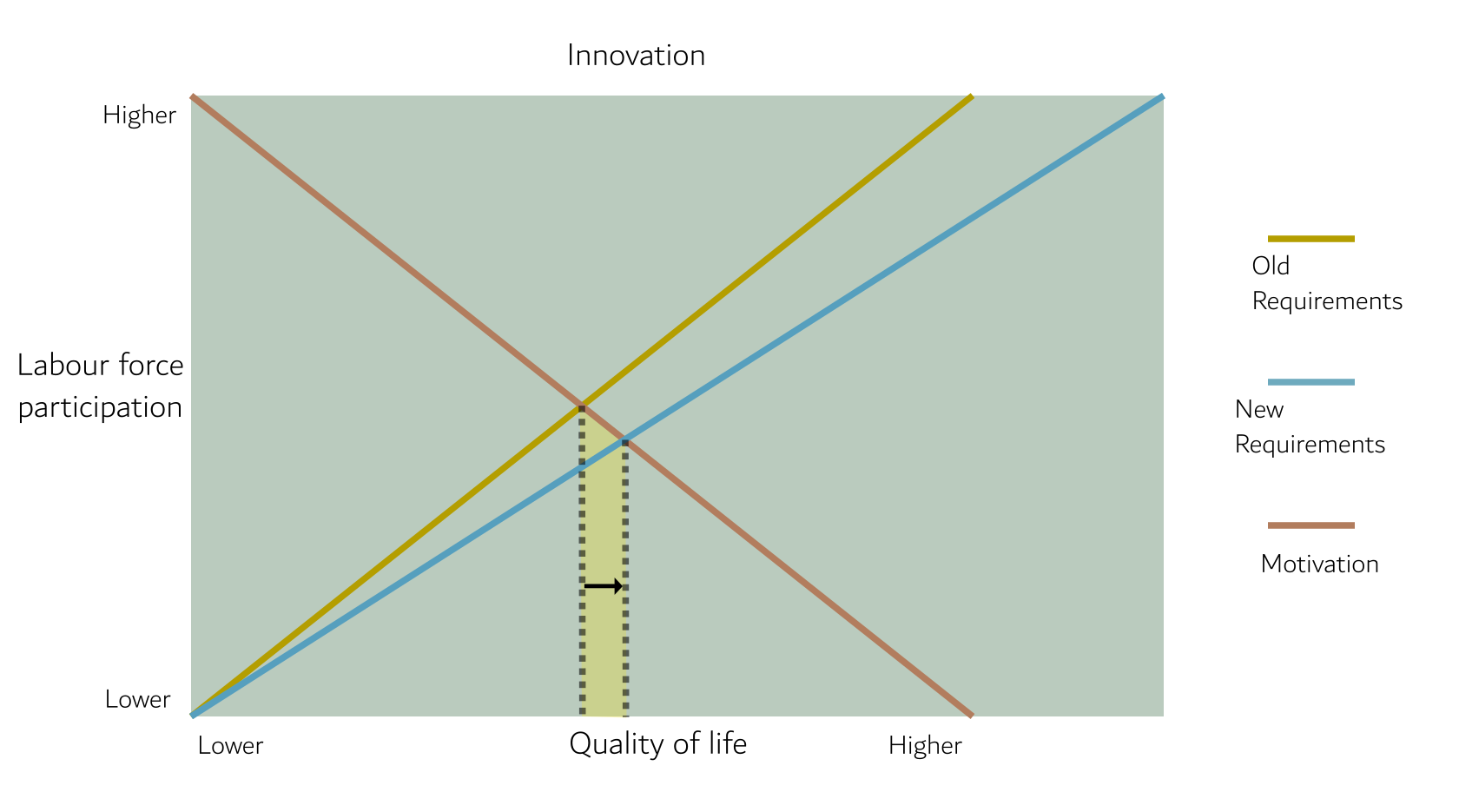
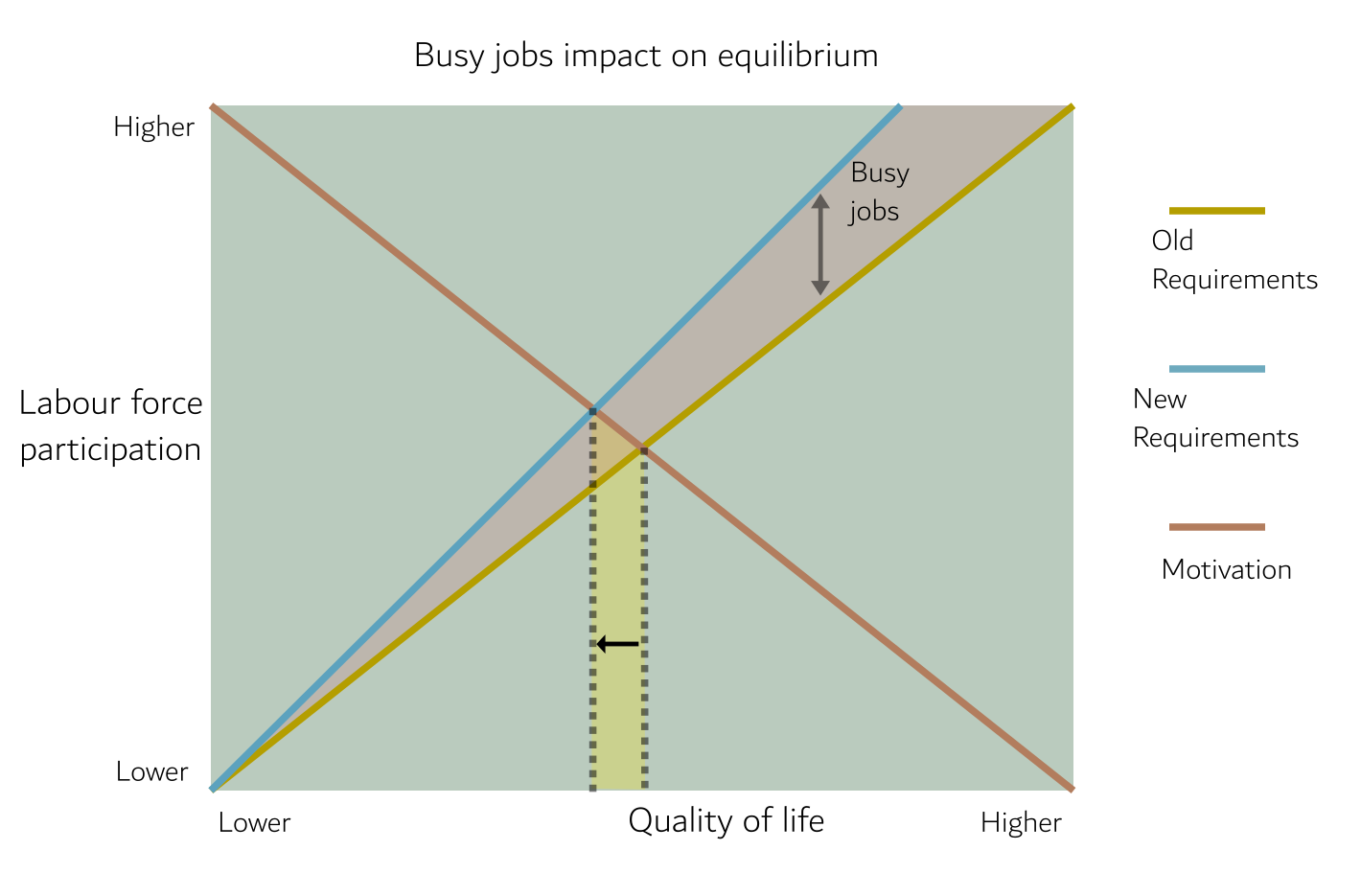
But innovation is something that happens over time, and I am, for the moment, going to assume that it is the same for both economic models. The other way we can change up worker requirements to have an impact is to make jobs produce less quality of life improvements. We could do this by adding necessary but unproductive jobs, which are inefficiencies of the system. This, intuitively, takes quality of life backwards - more people are working for less quality of life improvements:
The other thing we can change is the UBI amount. If we were to give more UBI, we might expect to see less people working as more people would reach their acceptable quality of life. On the other hand, if we decrease UBI, we might expect to see more people working because they haven't reached their acceptable quality of life. Now, this isn't strictly true, because good quality of life often encourages people to work, but I'll examine the worst case scenario here where it doesn't. On the other hand, restrictive welfare can cause less people to work, but let's also assume here that the UBI is sufficiently generous that no one reaches this condition of stress. I've made these assumptions to be as charitable to the exchange economy case as possible: that no one is in dire poverty and that monetary motivation to work is at least partly effective.
If we reduce the UBI and it motivates more people to work, we should expect to see more people in productive jobs and a higher quality of life:
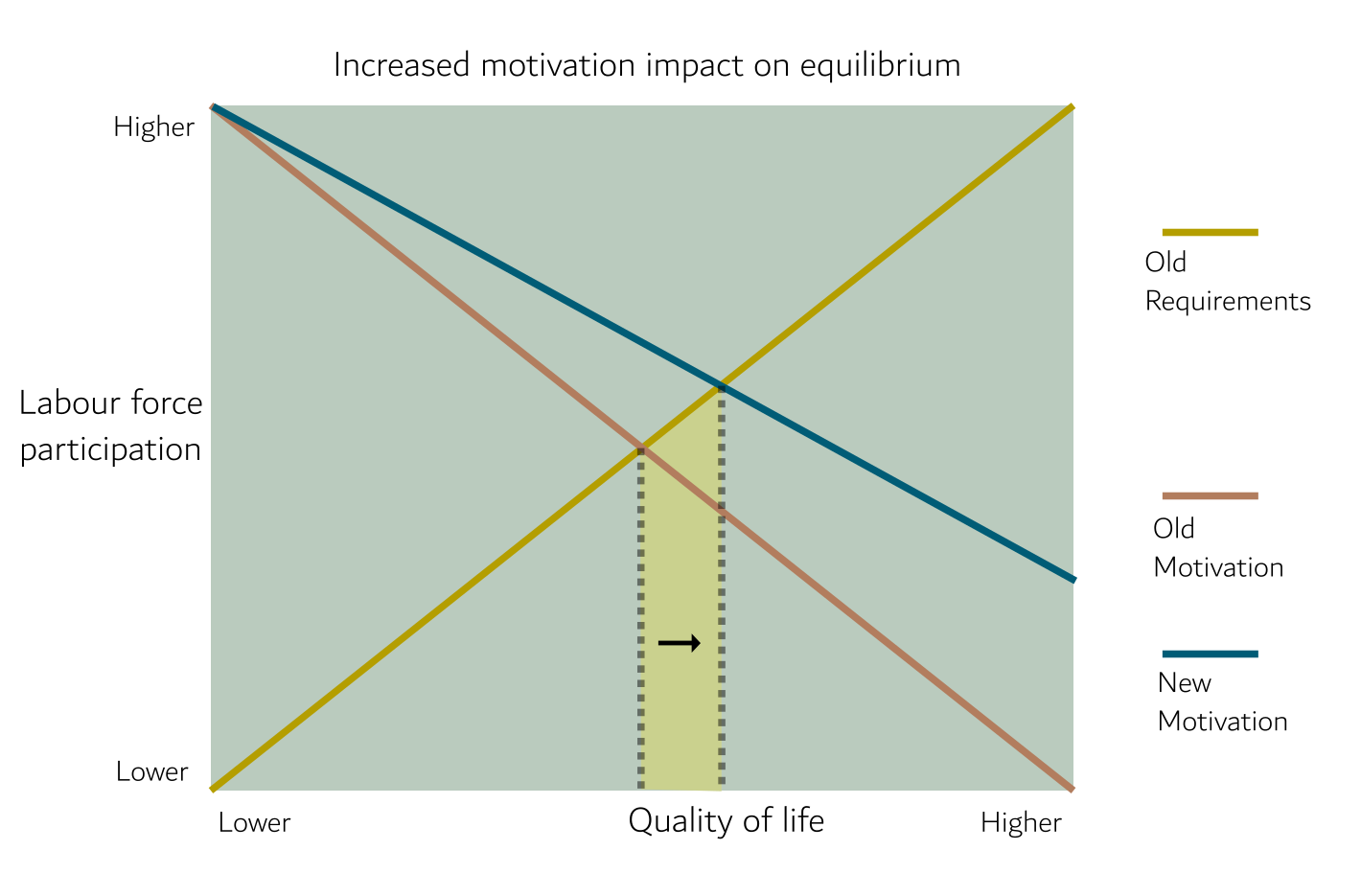
If we were to decrease the UBI to as minimal as possible, we should be able to ensure the highest rate of worker participation in the economy, and therefore the highest quality of life.
However, in the model described above, the extra workers were already satisfied with their quality of life, and therefore they don't gain any extra quality of life as a consequence of the work - in fact, their quality of life is presumably decreased because now they can't do and enjoy all the things that were going to satisfy them. In that sense, the jobs they are doing are busy jobs. With this in mind, I think we can reconceptualise the graph. When we motivate more workers to work who were already satisfied with their quality of life, we are actually reducing their quality of life. The graph that illustrates busy jobs, lower quality of life and higher amounts of workers has already been introduced:
My suggestion is therefore that in an exchange system without an optimal UBI, instead of conceptualising paid work as an increase in motivation to work, it should be conceptualised as an increase in busy jobs, which increases the amount of work required for any particular quality of life instead of increasing quality of life with increased workers. This principle applies even if the reluctant workers are producing a higher quality of life for others, because concern for others is already included in the quality of life "baseline".
There are also more jobs required for quality of life in an exchange economy than in a non-reciprocal gifting economy, because there are jobs required for money production and circulation, exchange contract faciliation, arbitration and enforcement, in financial markets and to offset risk such as through insurance.
There's also a slightly different way that you could draw this graph. In the original graph, the number of workers goes down as quality of life improves, as each worker decides that they don't need to work any more to achieve the society they want. But in an exchange economy, many of hte benefits of society are withheld unless people pay, and so people are required to keep working - in other words, there is pressure to keep a minimum number of workers always working. We can see this in the motivation to have a fairly low unemployment rate. So we could take the original graph and draw a line for the "floor" of worker numbers that the exchange economy pressures, and see where it intersects:
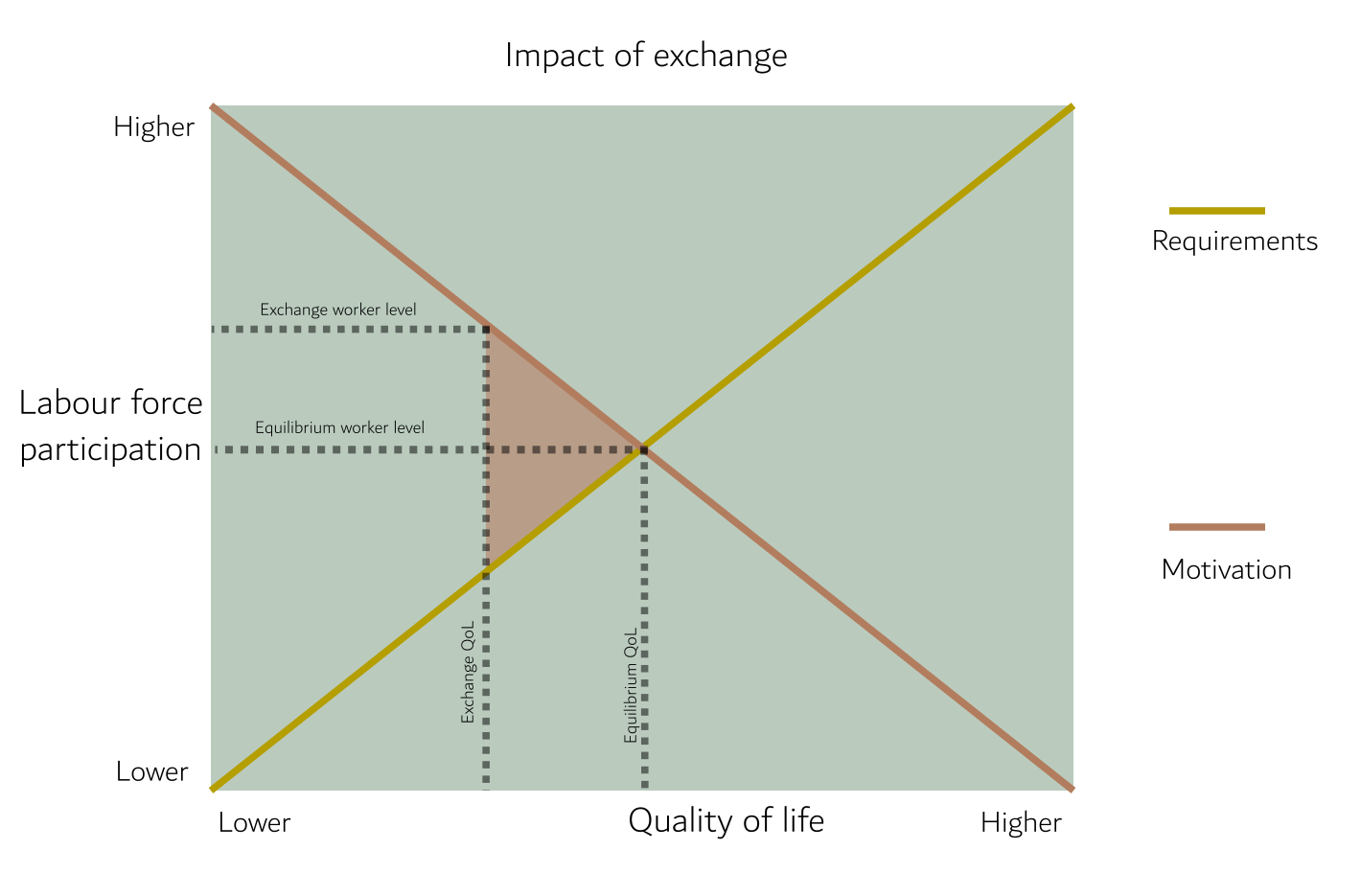
This graph suggests that by adding more workers than the equilibrium point requires, we are lowering the potential quality of life - this gap represents the busy jobs. This is pretty similar to a classic supply and demand graph in mainstream economics, where the horizontal axis represents quantity (instead of quality) and the vertical axis represents price (rather than labour). That graph proposes that it costs more to make more things (the way that we need more work to get a higher quality of life) and that at higher prices less people are willing to buy the product. There is then an equilibrium point where the price should settle (and tell producers how much to produce), the same way there is an equilibrium point where the number of workers will settle (and determine the overall quality of life).
In this classic economics graph, if you tax a good, you raise the price beyond the equilibrium point, but that will reduce how many people are willing to buy it, lowering the amount to be produced. This is often called an economic inefficiency, because the amount to be produced and enjoyed by consumers is lower than the "natural" amount. This difference is called the deadweight loss.
The parallel I want to draw is that by implementing an exchange and making people work who otherwise wouldn't, we've introduced a type of "tax" that increases the "price" (the amount of labour effort people have to put in) and reduced the overall "productivity" (quality of life), resulting in a deadweight loss. This deadwight loss is represented by the red triangle above, and the price that we pay is unnecessary labour.
The point is that under this model, an exchange economy is actually less economically efficient.
Some examples
Imagine, for example, a society of 100 people, all capable of work, where the equilibrium is that 40 people work. If any fewer people worked, the quality of life would drop and motivate another person to work. What would happen if we, for example, forced another 10 people to work?
To answer this, it might be useful to give a metric to the quality of life improvements we are expecting to see. So let's say that for every person who works, 2 more people are satisfied with the quality of life that results. So when 40 people work, 80 people are satisfied. This leaves 20 unsatisfied people. If we then motivate 10 extra people to work, the satisfaction number should increase to 100 people, which means that the entire society finds the quality of life satisfactory. Is it not then worth motivating the extra 10 people to work?
I think there are three problems here. The first is that to implement a system that motivates people to work involves work itself, which means that there is cost involved that would otherwise not have to be paid. And while we might quibble that this is a busy job or not, it is certainly a type of unnecessary effort. The systems we have currently - the exchange, punitive welfare, and so on - are rather costly.
The second is that the 10 workers are likely to have a lower quality of life if they were people who otherwise would not have worked, so our maths about how many people are now satisfied becomes more complicated - we should be adding some and deducting some. But even if that were the case, we could set 20 workers to the task, satisfy 40 more people (leading to 140 people satisfied - more than exist in the society), and then deduct the 20 unsatisfied workers, leaving us with 100 people satisfied. That feels paradoxical, because the workers are both satisfied and unsatisfied, and probably occurs because we were adding in hypothetical people. And this paradox remains regardless of who the initial dissatified people were - whether they were working workers, potential workers, or a combination.
But more fundamental is the third problem, which is that the whole notion is incorrectly framed. If 40 out of 100 people are working, but only 80 out of 100 people are satisfied with the quality of life, then there are likely up to 20 dissatisfied people who could potentially work, and it is unlikely that 40 is the actual equilibrium.
This holds up even if there are non-workers who are unsatisfied with the quality of life. Imagine a society of 200 people, of which 100 are non-workers, and 100 are potential workers, 40 of whom are working. Imagine, too, that each worker now produces a quality of life increase that satisfies 4 additional people, meaning that our 40 workers can satisfy 160 out of the 200 people. By adding in 10 more workers, we can fill that 40 person gap, ensuring that the non-workers have a satisfactory quality of life as well. But, if the new workers already cared about the quality of life of the non-workers, they would already be working. And if the existing workers don't care about the quality of life of the non-workers, why would they be motivated to increase the number of workers? It is likely, therefore, that the existing workers would be interested in the quality of life of the non-workers, and the results of their work would be directed at improving the quality of life of the non-workers and not the potential workers. If, then the potential workers were dissatisfied with their quality of life, they would begin working - indicating that the equilibrium was not really at 40.
The exchange isn't better
People aren't as simple as these models imply, and neither is the economy. What I've written above isn't some iron-clad, fool-proof reasoning (and I am suspicious that nothing in economics can really make that claim), but I think that it is indicative of the problems and benefits of the different economic models. In general, I think it it suggestive that free riders are not some type of force that will bring down the economy if not forced to work, and that motivating people to work above the baseline motivation trend is more likely to introduce inefficiencies and a lower quality of life, rather than improve the quality of life overall.
For example, think about a person who owns a mansion and employs a host of cleaners, gardeners and other staff. In a non-reciprocal gifting economy, these people would only come and work at the mansion if they believed that it was a useful and meaningful thing to do, or something that they genuinely enjoyed. But if they all stopped work, and the mansion and its gardens fell into disrepair, there would not be any change to the overall meaningful productivity in the world - there would not be less food, less medicine, less energy production, and so on. The mansion and its cleanliness produces none of those things. These jobs are busy jobs. And, furthermore, there would now be more people available for jobs that benefit society, such as teachers and doctors and nurses and so on. So why do people work in these jobs? Because otherwise they would starve, even though there is enough food to feed them. Because otherwise they would be homeless, even though there are enough homes to house them. Because otherwise they would die, even though there is enough medicine to help them. And, worse, not only does their work not produce any of these things, it still may not be enough to allow them to obtain them when they need them. That is the nature of the exchange: to create more work and lower quality of life.