How does an exchange economy actually work?
In a pure exchange economy, the only economic activity would be exchanges, and they would allow society to rationally allocate resources to where they need to go. Not many people genuinely believe this is the best type of economy - perhaps some economists from the Austrian school and some libertarians. But the basic idea - that exchanges are necessary for widespread ratonal allocation and that other types of economic activity can be distortive - is shared by a wide variety of mainstream (and non-mainstream) economists.
To try and illustrate the issues with an exchange economy, I'm going to start by exmaming a pure exchange economy, and then looking at what problems it has and how it tries to solve them.
How does a pure exchange economy work?
I'm going to start with a very simplified economy that has two sectors: one where things are produced, and one where things are consumed. Between them are two basic interactions: one where consumers exchange their labour with the productive sector for money (that is, they work making things) and one where consumers exchange their money with the productive sector for things. So, for example, people work on farms, exchanging their labour for money, the farms produce food, and then people buy the food with the money they earnt from working. Or someone might sell clothes that they make for money, and use the money to buy food to live (paying themselves for their labour).
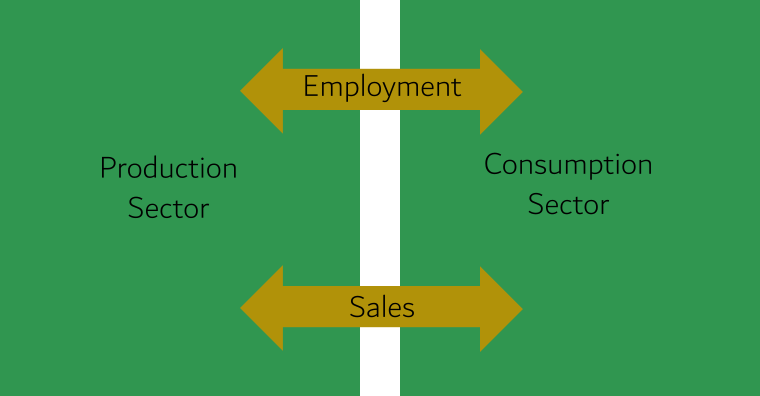
Obviously the economy is more complicated than this: businesses sell things to each other, for example. But this is a clear overview of an economy where resources are only transferred through exchanges.
This model of the economy is wrong, however, because it misses a very important factor: not everyone works. In this simplified model, I've made a single category for all the consumers and all the workers, which gives the impression that consumers gain their ability to buy things from the market due to the remuneration from their labour. There are two fundamental exceptions to this, however. The first is that some people have assets and savings and don't need to work. Either they are pure consumers who provide no labour, or they are consumers who also provide capital to the productive sector as an investment (that is, they exchange some money for the opportunity of more money later). It might seem a little bit strange to put this aside, but I am going to, and I will pretend for the moment that investing is the same as labouring: the person provides something necessary for production, and is remunerated for it.
The second missing group are people who do not work because, for some reason, they cannot. Such people exist, of course. There are babies, the elderly, the injured, the unwell, and some of the differently abled. These people may also not be able to invest in production either, especially if they couldn't work to accrue savings or weren't born with any.
So the consumption sector needs to be split up differently. There are multiple ways to do this, and it can get pretty complicated, but I am going to stick with just one simple one for a moment. I'm going to split the consumption sector into two groups: one which can contribute to the productive sector directly with either labour or investment, and one which cannot. Realistically, even if this were the only way to frame it, this should still be a continuum between people who can contribute a lot and those who can contribute nothing at the other and those who can contribute some in the middle, but I am going to imagine a clear cut line between them just for simplicity.
On one side of that line are the people who can contribute directly and receive enough remuneration from their contribution to satisfy their own needs by buying from the productive sector: that is, there is enough remuneration from the productive sector for their contribution that they can satisfy their needs. On the other side of the line are those people who cannot contribute a sufficient amount that their remuneration will cover their needs. In this group are people who have basic needs - leet's say survival needs - that are unmet through exchanges.
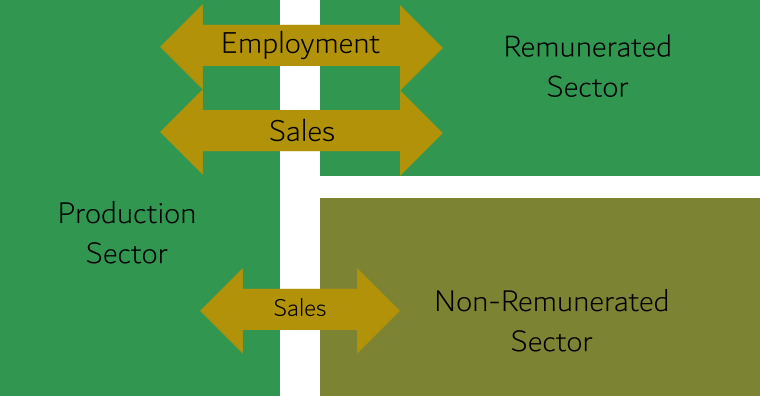
The big question for a pure exchange model is: How do these people live, using only exchanges? How do they get enough food, medicine or shelter to survive? The short answer is that the exchange cannot provide this - if there is nothing contributed, there is nothing received in return. This is a problem for a pure exchange economy, because it means that there is an entire population of people who are unable to have their needs met, which I raised earlier as an indicator of poor economic health. Moreover, a lot of these people are future labourers, which means that the future health of the economy by any metric is at stake.
There are still a few proposed answers from people who advocate for something close to a pure exchange economy:
Insurance and loans
One possible answer is insurance. This still constitutes an exchange, because the person is paying for a service and receiving that in return.
Insurance is useful in some circumstances, such as when a person who is employed pays into an unemployment insurance that pays out when they are unemployed, or when insurance covers a person when they are ill, or their house has been destroyed, and so on. We can even include under insurance a private pension, which someone pays into while they work and which pays out at retirement age.
The obvious issue here is that there are people who cannot pay into insurance in the first place. Even for a person who works and receives remuneration, insurance may be beyond their threshold. That is, if their remuneration does not cover the cost of their basic needs plus insurance, then this option is unavailable to them. Without even enquiring into the various cost-structures of different types of insurance, this option is not available to everyone.
Loans are similar. A loan is a type of exchange where someone receives a resource (money now) in exchange for another resources (more money later). A person could receive a loan to help them pay for any needs that are not covered by their remuneration, but the issue is that they would later need to pay the loan back. This is okay for people who can gain more remuneration later (or know that they will have less needs), but that does not cover a significant portion of the population. Moreover, many loans a predatory or problematic. Because it is still a type of exchange and the person giving the loan wants to gain out of it, loans come with interest, and the riskiest loans often have the highest interest, which either makes them less accessible or likely to make debt escalate. Loans, credit cards, and mortgages are all commonplace.
Intangible exchange
One answer is to conceive differently of the exchange. At the outset, I defined the exchange as the agreement for two parties to transfer specific resources to each other, and I excluded intended intangible outcomes from that. But some people include intangible and non-guaranteed outcomes as part of the exchange. With this line of thinking, an excnage could occur where a person transfers resources (food, medicine, etc.) to an ill person unable to work, and receives in return a sense of love, moral satisfaction, social standing, or something else.
If the exchange is considered this way, then this can resolve the issue that a pure exchange economy has. But it does add a host of ambiguity to the concept of the exchange once it covers things that are not explicitly agreed to and which are not guaranteed to be received. Instead, I'll examine this sort of case in the next article in a different framework, one where this doesn't constitute an exchange because there is no guarantee or agreement about what is being transferred.
Households
A final answer is again not an economic activity but another re-framing of ideas. Economists have traditionally considered the core consumer unit not the individual, but the household. The head of the household was the worker, while the spouse and children were some form of dependent. In this type of framing, the head of the household is considered in economy theory, while the others are simply considered some sort of attachment to the main actor and not independent economic actors themselves.
Under this framing, the worker can give food, resources and money to the other members of the household without it constituting an economic activity. Thus, if a child needs food, and eldering person is looked afer by their working child, or a spouse cares for an ill loved one, these are all facilitated by an exchange: the exchange between the worker and their work. The distribution within the household is supplementary.
There are two massive problems with this. The first is that it erases a whole group of people - often women, children, the unwell, the elderly and the differently abled. Although the household is not as common as in previous economic paradigms, it is still used in various ways and it is problematic that classical economics ignored an entire set of people and their needs and contexts. It also ignores that these resource transfers can break down - children can be neglected, spouses held under financial control, the elderly and unwell abandoned.
The second problem is that it erases an entire type of economic activity: gift-giving. The way in which resources are distributed within the household is through gift-giving, where workers earn money and buy resources and gift both of these things to other members. The focus on the exchange as a preferential type of economic transfer has led to some people conceiving of the economy in such a manner that they render other types of economic activity completely invisible. By lumping various people together into a "household" and defining the remunerated worker as the economic actor that represents the household, and by ignoring the other people and economic activities within the household, the classical economist can continue to claim that the exchange is primary. But I think that this represents a sleight of hand that allows people to tell the economic story one way.
However, once we open up the concept of the household and examine the things inside, the model should look like this:
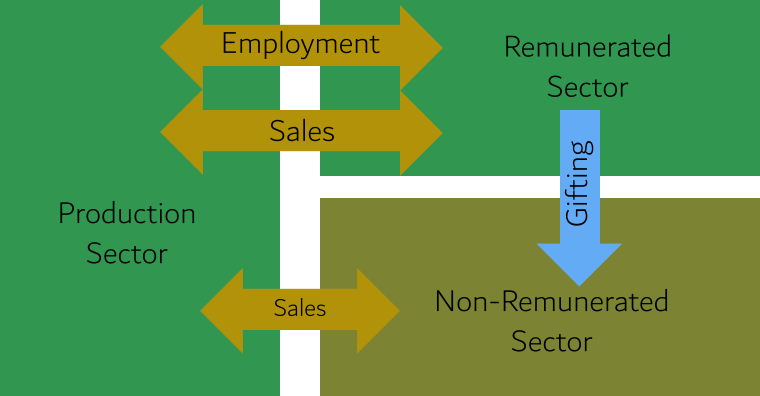
Here, there are a group of people who are not remunerated through work (or are not sufficiently remunerated through work to meet their needs) who receive resources through gift-giving. Gift-giving is a solution to the issue of ensuring people's basic needs are met (in fact, I will go on to argue that it is the only solution), but it is definitely not an exchange. A pure exchange economy cannot meet these people's needs, which is problematic by various metrics of a healthy economy, and a problem for the future of the economy.
Pure exchange economies don't have a solution for under-remunerated people; they need to rely on some other method of transferring resources to these people. In the next article, I want to show that the only real solutions are gifting solutions.