How mixed economies work
Pure exchange economies can't work - they just can't get resources to satisfy certain types of needs using the exchange. Most economists don't advocate for a pure exchange economy. And most developed liberal market economies don't simply let everyone who cannot be sufficiently remunerated through the exchange suffer or die. Instead, these liberal market economies find solutions to direct resources to these people, and those solutions are almost always a particular type of resource transfer, which I call non-reciprocal gifting. This happens through private organisations, government organisations, and through family and community. An economic system that includes a significant focus on both the exchange and some other type of transfer is a type of mixed economy.
Non-reciprocal gifting
Each of the solutions outlined below are examples of non-reciprocal gifting. While the exchange is a type of resource transfer between both parties where each party voluntarily agrees to transfer certain resources to each other, a non-reciprocal gift is a type of resource transfer where both parties voluntarily agree that one will transfer resources to the other without creating any obligation or expectation of reciprocation.
Gifters can still choose who they give gifts to, and they can decide only to give gifts to people in relevant contexts (such as gifting medicine to those with illnesses that can be treated by it). I go into more detail on this in the next section on gifting. But the fundamental distinction between a non-reciprocal gift and an exchange is that the gifter does not receive anything specified or guaranteed in return, and has no expectation of such.
Thus, any example of a person or party being transferred resources with no obligation to return any resources is a non-reciprocal gift.
Private organisations
The most common type of private organisation that engages in non-reciprocal gifting is a charity.
Charities both receive and transfer out resources through gifting - people donate to charities without any expectation of receiving something in return, and charities gift to particular target groups without expecting anything in return. The gifts can be goods, services or money. Each gifter considers the condition upon which they are giving the gift - for example, the person donating to charity will consider what the charity is for and how trustworthy and legitimate they are, while the charity will consider which people need the relevant resources.
Government organisations
There are three or four main types of gifting done through government organisations: directly to individuals as money, the provision of services that individuals can access, to charities, and to businesses.
Targeted payments directly to individuals is usually called welfare. Most of the time there are qualifying conditions to receive the gift (for example, being disabled, unemployed, a single parent, and so on), though there are proposals for payments that have no qualifying conditions except citizenship of a state (such as a Universal Basic Income). These payments are almost always made in recognition that the people receiving them are unable to use the exchange to satisfy their own needs. Some, however, are targeted at groups that the government wants to entice to behave certain ways, such as incentivising the installation of solar panels or encouraging people to have more children.
The provision of services is often done for two reasons: first, to help those who would not otherwise be able to afford the services, and second, to ensure that the services are produced (and within a particular budget) when they otherwise might not be. Healthcare and public transport are straightforward examples in many market economies. For example, welfare might allow a person with little exchange capacity to afford food or rent - both things that the market is incentivised to produce anyway, but which are not financially accessible to all people. On the other hand, welfare might not be able to incentivise the market to produce certain costly healthcare products, and so the government orders them or produces them directly.
Governments also provide financial support to charities - rather than replicate their organisations, they utilise them instead.
Finally, governments provide gifts to businesses. These often take the forms of grants or stimulus. Again, there are various conditions that they might apply - like most areas of government gift-giving, there is a qualifying requirement identified through paperwork. Grants can also be competitive, with a finite amount given out and potential recipients competing for the resources. Grants might be given out to fund businesses or projects that are not viable in markets, such as various art and entertainment projects, community projects, infrastructure projects, and improvement projects - for example, to run a festival, create a community garden, provide road safety improvements, and the like. Stimulus, on the other hand, may often be less targeted, because the idea is less about encouraging specific projects and more about adding liquidity to the market. That is, stimulus during a crisis or recession can be useful because it can increase consumer spending and business production.
There are two significant things to note about government gifts, however. The first is that some governments have a habit of asking for the money back after the fact. For example, if the government gifts money on the basis of, say, unemployment, and the government later believes that the person was not, in fact, unemployed, then the government may ask for the money back. The same often applies to grants. This doesn't quite match up with the definition of non-reciprocal gifting, in that the conditions can be applied afterwards and that the money can be recovered. This is actually a tension between the nature of gifting and the nature of the exchange, where the one-way transfer of resources is seen as necessary but the context in which it is evaluated is a budgetary one.
The other factor is tax. Governments make the argument that they can only afford to pay out welfare from a pool of revenue generated by tax. (The Modern Monetary Theory argument is that tax reduces inflationary pressures that can be caused by government spending.) In either case, governments use a third type of resource transfer that is neither non-reciprocal gifting nor the exchange, which I'll call requisition. This is a one-way transfer of resources (like a gift) but where it is only voluntary for the recipient, and not the gifter (unlike the gift). The government can compel the movement of resources towards itself. This is seen as necessary to be able to provide welfare, services and grants.
The additions needed to an exchange economy in order to make it function, therefore, are many and complicated. The picture is no longer of the productive sector, the remunerated and the under-remunerated, but also of the government and an extra type of economic transfer. Filling in the holes in the exchange economy requires a host of scaffolding.
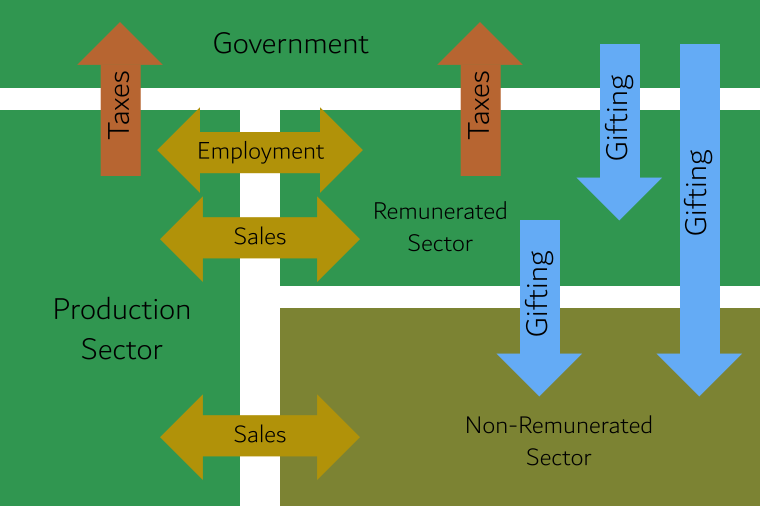
Community gifting
The other main source of non-reciprocal gifting is done through community channels, such as volunteering and unpaid work.
Volunteering is generally the term for unpaid work where the work is done for people or purposes outside of the "household". There are at least two categories: those where it is done for the immediate community in a non-professional capacity, such as volunteering to help at a child's school, and where it is done in a professional capacity and may be outside the immediate community, such as volunteer firefighters, doctors and educators. In some places various emergency response services, such as firefighting, storm damage response, car accident response and others are done by in part by volunteers, and many people's access to medical care is only available through volunteering.
Unpaid work is work that goes unpaid either within the household or within a workplace. A lot of this work is unpaid "domestic" work, and including cooking, cleaning, child-raising, caring for family members, house and property maintenance and improvements, and the like. Unpaid professional work includes things like unpaid overtime at existing workplaces, internships, and similar.
One argument made is that these are not "economically productive" jobs because they are jobs that everyone has to do for themselves anyway; that is, it is just a general expectation that people cook their own meals and clean their own houses and this shouldn't be considered in an evaluation of the economy. The other view is that if these are jobs that people are regularly paid for, and if these are jobs that people do for other people, then they are legitimate productive jobs. For example, people are paid to cook meals in a professional capacity, to care for children and ill and elderly people throughout the day, to clean houses, and so on. There is also the consideration of opportunity cost: a person who cares for an ill relative has less time to participate in remunerated work. These jobs also support workers, such as the traditional expectation of a spouse maintaining the house, doing the washing and the cooking and other chores, while their partner earns money in the market. The money-earner is perhaps able to be more productive at their job because they do not have to spend time and energy maintaining the house.
Even families staying together can be considered a form of gifting: if an adult child or elderly parent stays at the house rent-free, this is also a form of gifting - one that saves people from homelessness if housing prices are high or aged care is too expensive.
The solution is always gifting
So far I've spent a lot of time illustrating that the exchange causes a host of problems, a major one of which is that people have clearly defined survival needs that simply cannot be met through market exchanges. The solution to this type of problem, in any exchange economy, is always gifting, whether it is gifting from the government, private organisations or the community, whether it is gifting that is done deliberately and consciously or whether people don't even realise that this is an economic activity.
The exchange causes other issues as well, such as businesses being motivated to cut corners or the need for continual economic growth, and the current solutions for these issues are generally regulation, causing a tension between the structural motivations of a system of exchange and the regulatory environment that tries to restrain them. But I want to suggest that there is a way to resolve these issues without this tension, and I think the solution for these problems are the same as the solution for meetnig people's basic needs: gifting.