What's different about a non-reciprocal gifting economy?
Here I want to flesh out some of the basic differences in a non-reciprocal gifting economy, and why I think it is a good starting point for investigating a better economic model.
Earlier, my critique of the exchange indicated that an exchange economy, like a liberal market economy, exhibited a variety of structural problems. These included what I called under-signalling, where people didn't have enough money to signal the market that they needed to be allocated resources, and counter-signalling, where disadvantage tended to reduce exchange capacity but increase needs all at the same time. I also identified signal inversion, where the exchange value of something exceeded the use value of something, leading to products not getting to end users, and market speculation that could lead to market crashes. Here, I'm going to make some comparisons with those issues and see how they would play out in a non-reciprocal gifting economy.
For a moment, I'm going to ignore the human behaviour component of the economy - that is, I'm going to put aside the question of if people would really be motivated to give gifts and volunteer labour. I will come to that in the next section. For now, I just want to explore what the base logic of a non-reciprocal gifting economy would look like.
Non-monetary economy
The first big change is that while an exchange economy needs a medium of exchange in order to function well, a non-reciprocal gifting economy does not need a medium of exchange. In an exchange, both parties need to transfer something of value, and if they both don't have the thing that the other one needs, they can't complete the exchange. Money, as a sort of placeholder of value, allows them to complete the exchange, with the recipient of the money knowing that they can exchange the money for something that they do want later.
When someone transfers a resource as a non-reciprocal gift, they don't need anything in exchange. This makes the transfer a bit easier, because they don't have to negotiate with the other party regarding the value of the thing being transferred, and they don't have to worry about whether the recipient can pay for the thing. This also means that there is no need of a medium of exchange, which is one of the primary roles that money plays.
Money does play some other roles as well: typically, a store of value and a unit of account. But, without exchanges, these roles are unnecessary as well. For example, if there are no exchanges, people do not need to save up exchange capacity in order to obtain something of great value. As a consequence, they do not need to store exchange capacity over a period of time, and so the store of value function of money - which is the ability of money to pay for roughly the same amount of things tomorrow or next year as it could today - is unnecessary.
Similarly, if two people are going to exchange things, they need a way to measure whether they are exchanging things of roughly equal value (even if one of those things are money). This is easiest if you can put a number on things, which is part of the usefulness of the price. This measure or number is the unit of account. With a unit of account, we can try to compare almost anything with almost anything else, such as apples and houses, cars and holidays, oil and fish, using the price. We can also, controversially, put a number on things like human life. But with no exchanges, there is also no need for a unit of account.
A non-reciprocal gifting economy being a non-monetary economy has a range of impacts. A lot of the issues with the exchange are caused by the way that value is assigned to goods, and whether that assignment is correct or incorrect. Without money and exchanges, several of these problems simply do not exist.
Exchange value
In the critique of the exchange I proposed a theory of value that contained three different types of value: cost-value, use-value and exchange-value. I proposed that where use-value was higher than cost-value for a good, society would generally want to make that good, and where it was the reverse, society would not want to make that good. I also noted that where exchange-value was higher than cost-value but lower than use-value, the good would transfer through the market somewhat ideally. But in every other circumstance, I identified that there was a problem - if the exchange-value was lower than the cost-value, the good would not be made, even if people found it useful and necessary, and if the exchange-value was higher than the use-value the good might not reach the end user and instead be a speculative asset of some sort.
A non-reciprocal gifting economy doesn't have exchanges and, therefore, doesn't have exchange-value. A non-reciprocal gifting economy has use-value and cost-value, and so we can still say that if a good is more useful than it is costly society will think it should be made, and if it is more costly than it is useful it will not be made. But without exchange-value, there is nothing that interrupts this very straightforward state of affairs.
Consider a medicine that has a cost to make and whom a set of people with a specific disease find critical for their quality of life. In an exchange economy this medicine would be made only if the users had enough money to pay the cost - if they did not (and, because the illness might prevent them from working and accruing exchange capacity, they typically might be unable to) the medicine would not be produced for them. Where the exchange-value (what the market can trade it for) is lower than the cost-value (the resources and labour that it takes to make the medicine), the product will not be made, even if the use-value (the utility to consumers as generally conceived by society) is higher than the cost-value. There is a way out of this, of course, even in an exchange economy: the government can subsidise the production of the medicine, or subsidise the price of the medicine for consumers, or provide the consumers with income that allows them to purchase the medicine. That is, if society thinks that the usefulness of the medicine is worth the cost, they can override the market by using non-reciprocal gifting.
A non-reciprocal gifting economy does not have this problem. If the use-value is higher than the cost-value, society does not need to override the market in order to ensure that the medicine is made. In the exchange economy, non-reciprocal gifting was the exceptional strategy required to achieve the outcome, whereas in a non-reciprocal gifting economy it is the ordinary effective strategy. Without the market to push past, there is no friction to work against. A non-reciprocal gifting economy jettisons the concept of exchange-value and simplifies (and makes more efficient) the resource allocation process.
In addition, with no exchange-value the goods that a person possesses will not have an exchange-value and will therefore not represent any exchange capacity. The relationship between a person and their goods is therefore fundamentally different, because a good does not represent exchangeable wealth.
In an exchange economy, if a good no longer has a use-value to a person, it can still have an exchange-value, and is therefore worth holding on to so that they can exchange it later for something that they want. Every possession also has a cost-value - the value of storing it, maintaining and protecting it - and if the cost-value is lower than the exchange-value it will be worth holding onto the good for its exchange capacity. However, in a non-reciprocal gifting society, when a good loses its use-value, it only has a cost-value, and is therefore less worth holding on to.
No under-signalling
Under-signalling is the name I gave to the circumstance where a person cannot signal the market to have necessary resources allocated to them because they did not have enough signalling power - in the case of a market, this is exchange capacity such as assets, money or labour. However, instead of exchange capacity being the signalling "medium", in a non-reciprocal gifting economy signalling is done through requests. Because people can't run out of requests in the same way that they can run out of exchange capacity, if a person has a fundamental need they will still be able to signal it. Similarly, the price of a good on the market is a hurdle requirement for someone to be allocated that good, but in a non-reciprocal gifting economy there is no such hurdle that prevents them from being allocated the good.
In an exchange economy, it is still possible (and often occurs) for a person to gift a good. However, because exchange capacity is necessary for that person's survival and the future is uncertain, there is a motivation to accrue exchange capacity. In a non-reciprocal gifting economy there is no exchange-value and therefore no exchange capacity, and greater motivation to pass goods on. Thus, even though gifting is possible in both economic models, there are motivations against it in one and motivations for it in another.
No counter-signalling
The same logic applies to counter-signalling. If a person experiences some disaster, such as an injury that prevents them from working, then this person has increased needs and lowered exchange capacity. This is often resolved in an exchange economy through savings or insurance (if they have the opportunity for either), or welfare. In an non-reciprocal gifting economy, gifting is, of course, the norm, rather than being an exception to the normal functioning of the market. The person will have increased needs but they will not have lowered, or exhausted, ability to be allocated resources for those needs.
Similarly, a person who has all their needs met in an exchange economy has the capacity to save and then make bigger purchases or investments, potentially setting them up for an increase in exchange capacity. In a non-reciprocal gifting economy having one's needs met does not afford them greater power of allocation.
No signal inversion
Signal inversion is when exchange-value exceeds use-value, so that the good has a higher probability of being withheld from the end user so that the holder of the good can sell it at an opportune time to maximise their profit, or as collateral for a loan or similar. The assets that are the subject of signal inversion are usually assets where people guess the price will generally continue to rise (and quicker than inflation). The issues come not just from withholding these goods, but also getting these guesses wrong, which can lead to market "corrections" where there is economic downturn or crisis.
In fact, in a non-monetary economy, all these financial instruments, including speculative instruments, would also not need to exist. Anything that exists to represent exchange capacity or a guess at prices would have no function in a non-reciprocal gifting economy. That would mean no shares, stocks, derivatives, bonds, insurance, interest, hedge funds, currency trading, and anything of the sort.
The result would also be less economic volatility. Some - in fact, a great many - economic crises are caused by speculation and debt of one sort or another. These factors would not be present, and so crises of that nature would no longer appear. That is not to say that an economic crisis could not exist - especially if natural disasters wipe out resources, for example. But stock market crashes that are driven by market corrections would not.
Dissolving the paradox of efficiency
In my critique of the exchange I mentioned the paradox of efficiency, which suggested that there was tension each time a labour efficiency improvement was found, because it was a threat to that particular group of labour, and that it had the potential outcome of creating "busy jobs".
I want to expand on this more in a later section, but I will note that without the motivation of both employers and employees to accrue exchange capacity, the paradox of efficiency is effectively dissolved. The core of the resolution is this: workers would no longer rely on accruing exchange capacity from their workplace, and so their survival would not be threatened by the reduction of work. This would mean that labour efficiencies could have quite a different effect: less time working. I'll tackle this more a little later.
Simplification
This overview presents a brief case that the major problems with the exchange are all resolved by implementing a non-reciprocal gifting economy. Perhaps that sounds a little too good to be true or a little too convenient. But I think that if this is the case, it could be because the issue is framed incorrectly. These problems, fundamentally, are not problems inherent to every economic model that could exist, and are solved differently by each of them. These are problems created by implementing the exchange, and so disappear when the exchange is no longer implemented.
When the exchange is implemented, there will be people who do not have exchange capacity. This is a problem of the exchange itself. The solution - government welfare, insurance, etc. - are necessitated by the original problem. When the exchange is implemented, there will be some costs that are difficult for an individual or business to bear, and the solutions - financial instruments, hedge funds, stocks, bonds - are necessitated by the original problem. The complexity of the liberal market economy isn't, from this perspective, because economies are naturally and inherently that complicated, but because placing the exchange at the centre of the economy necessitates that it becomes that complicated.
There are some market advocates - libertarians, anarcho-capitalists, die-hard Austrian school economists, and some others, perhaps - who imagine that this complexity arises not from the exchange being the centrepiece of the economy but from government intervention. They depict the economy according to the graphic that I presented much earlier:
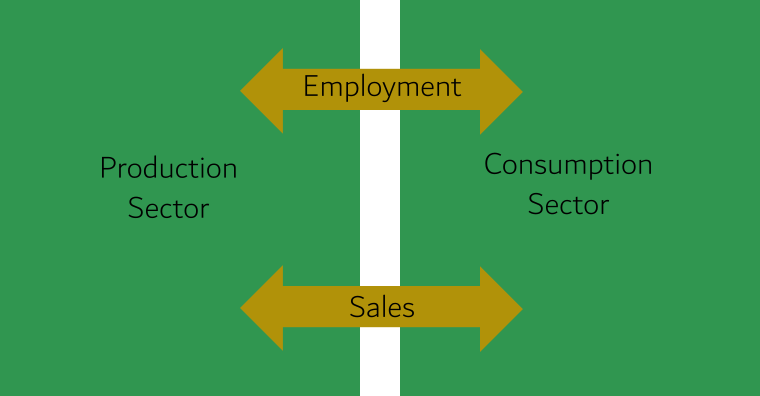
But, as I noted, this depiction is too simplified, because it misses out those people who do not or cannot receive remuneration, and who therefore cannot have their needs met through exchanges:
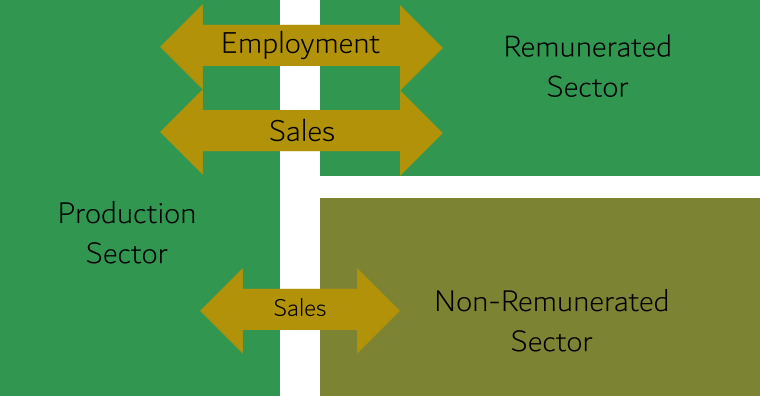
The solutions that have been implemented in markets have generally been non-reciprocal gifting solutions, either non-institutionally:
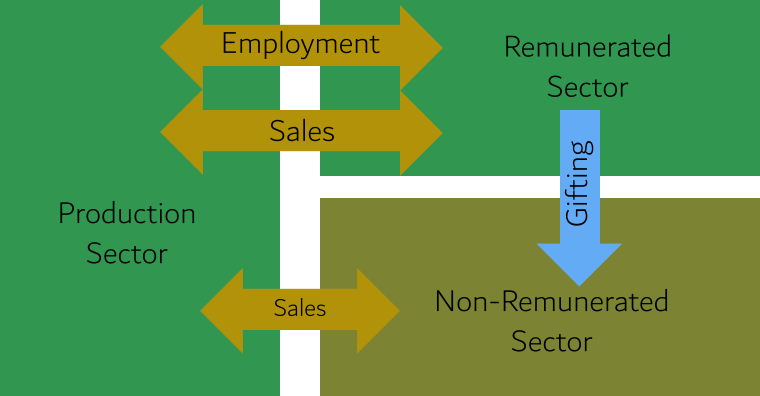
Or institutionally, involving taxes and governments:
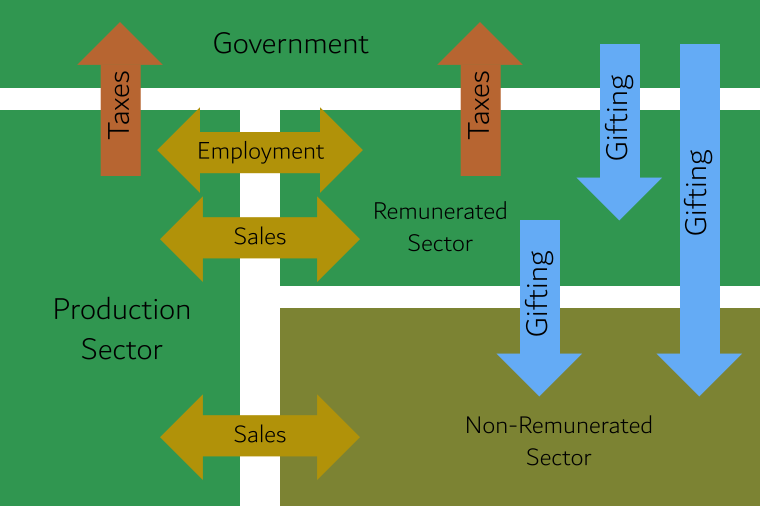
An enormous amount of this stems from the unremunerated portion of the populace, and how to ensure that they receive an allocation of necessary goods. But this unremunerated portion only exists as a separate category because of the nature of the exchange. When the exchange is replaced by non-reciprocal gifting - or, rather, when the exchange is removed, given the non-reciprocal gifting is already present - this categorisation disappears as well. That leads to a model of the economy that looks more like this:
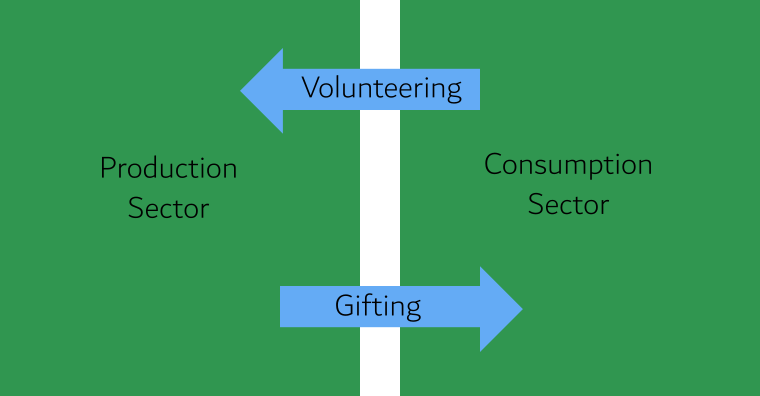
In this model of the economy, things get to where they need without having to add in an extra type of economic transfer to accommodate for the gap, because the gap doesn't exist. This gap - perhaps a gap that a lot of people accept as inevitable or natural - is constructed when we imagine the economy as based around the exchange.
Without it, labour can volunteer to work and the results of production can be gifted to those people who need it, without the imagined barrier of the exchange getting in the way. The process is much simpler. The underlying nature of the economy isn't naturally that complicated- it is the exchange that complicates things. So non-reciprocal gifting is not actually solving problems so much as removing the cause of the problems in the first place.
Now, of course, the economy is not that simple. This description is still too simplified and leaves out a lot of detail. The two big issues are whether people would be motivated to gift and work in such an economy, and whether economic calculation could rationally and efficiently occur. I'll look at both of these questions in turn. But the point I want to start with is that a non-reciprocal gifting economy is simpler: it doesn't pose the same types of structural problems that need complicated and volatile workarounds.