Free riders and economic equilibrium
The rationally self-interested individual of neoclassical economics is a person who aims to gain as much reward as possible (however it is that they conceive of that) with as little effort or contribution as possible (however it is that they conceive of that, also.) Place this model of the individual into a non-reciprical gifting economy, where all resource gains are received through gifting and all work is volunteering, and the implication is that individuals will be likely to be free riders.
This is especially problematic if the contexts of each individual are identical, because each individual could think to themselves, "I could avoid working and still receive resources to live". The issue is, of course, if too many people take this course of action, then the economy will not have enough workers and would collapse.
This seems logically unlikely, and I'll set out the reasoning below, but the short version is: if quality of life is too low, people will not be motivated to be free riders. The result will be an equilibrium between free riders and workers that establishes a set quality of life.
Worker participation and quality of life
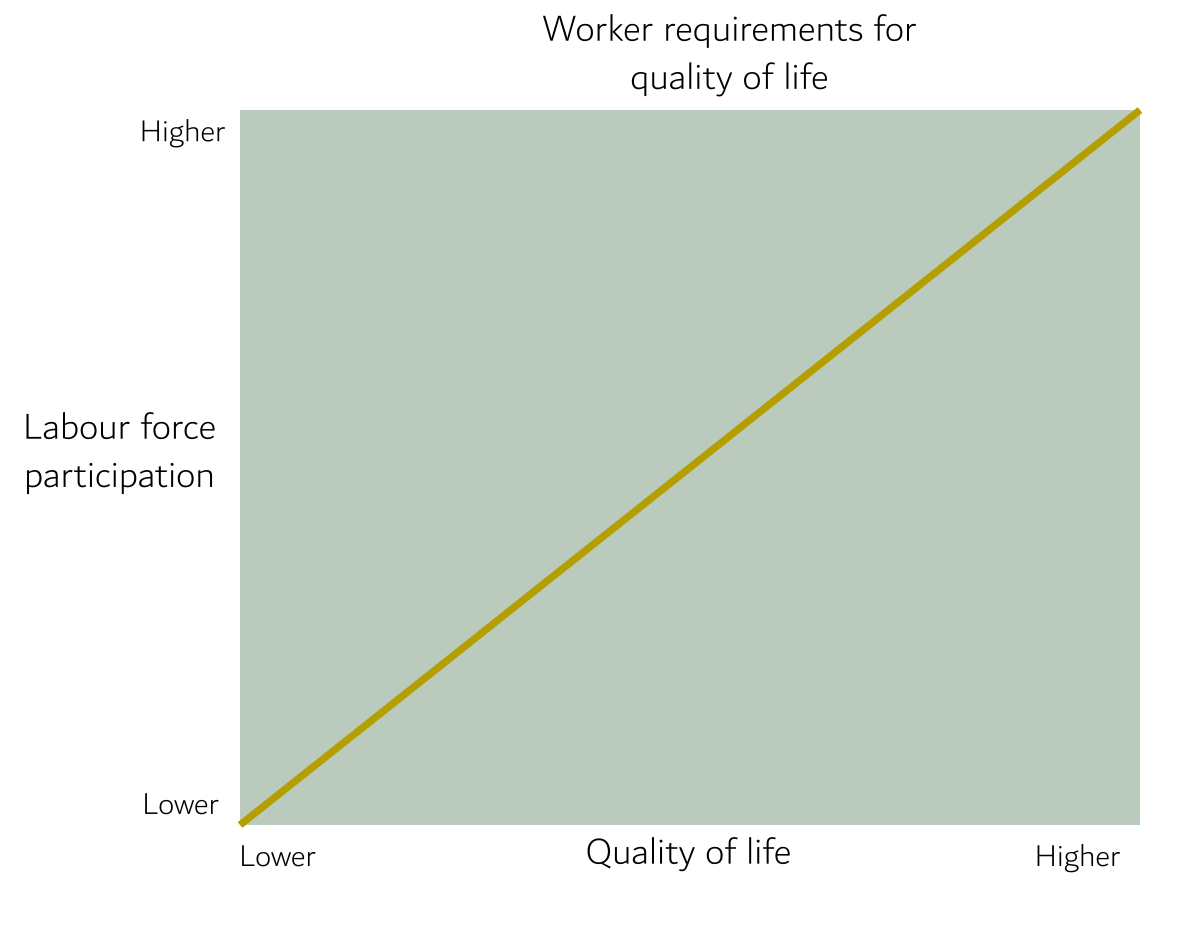
First I want to propose the idea that there is a relationship between the number of people working and quality of life for society. The relationship looks roughly like this: the more people are working, the higher the quality of life will be.
I'm not going to try and propose some particular standard or definition of "quality of life". Instead, I will just assume, for the moment, that there is some vague linear measure of quality of life, such that we could take any points of quality of life and say that one is higher than the other. The basis of this could be that each person has a self-identified set of needs in order of priority, and that their quality of life is higher the more of their needs are satisfied according to their preference. So, for example, if there is little food, probably most people would denote the quality of life as low, and if people live long, healthy enjoyable lives, probably most people would denote the quality of life as high.
I'm also not going to try and completely specify what constitutes "work" for this relationship, except to say that it counts as work if it productively goes towards improving the quality of life. This is why I think we can make a basic assertion that the more workers are doing work, the higher the quality of life will be.
For the moment I am also interested in people who can work, and people who do work. The number of people who can work provides us with the possibility space for quality of life, and we will safely ignore, for the moment, any quality of life that requires more workers working than actually exist. I am not particularly fussed, again, what counts as a person who can work - I think that there are problems with drawing such a line, but the moment I'll just pretend that a line can be drawn, without bothering to make a claim about exactly where it would be.
The result is that I have a highly simplified model, but one which I think is still useful and indicative. From this model, I think we can draw the following relationship, which suggests that the more workers working, the higher the quality of life:
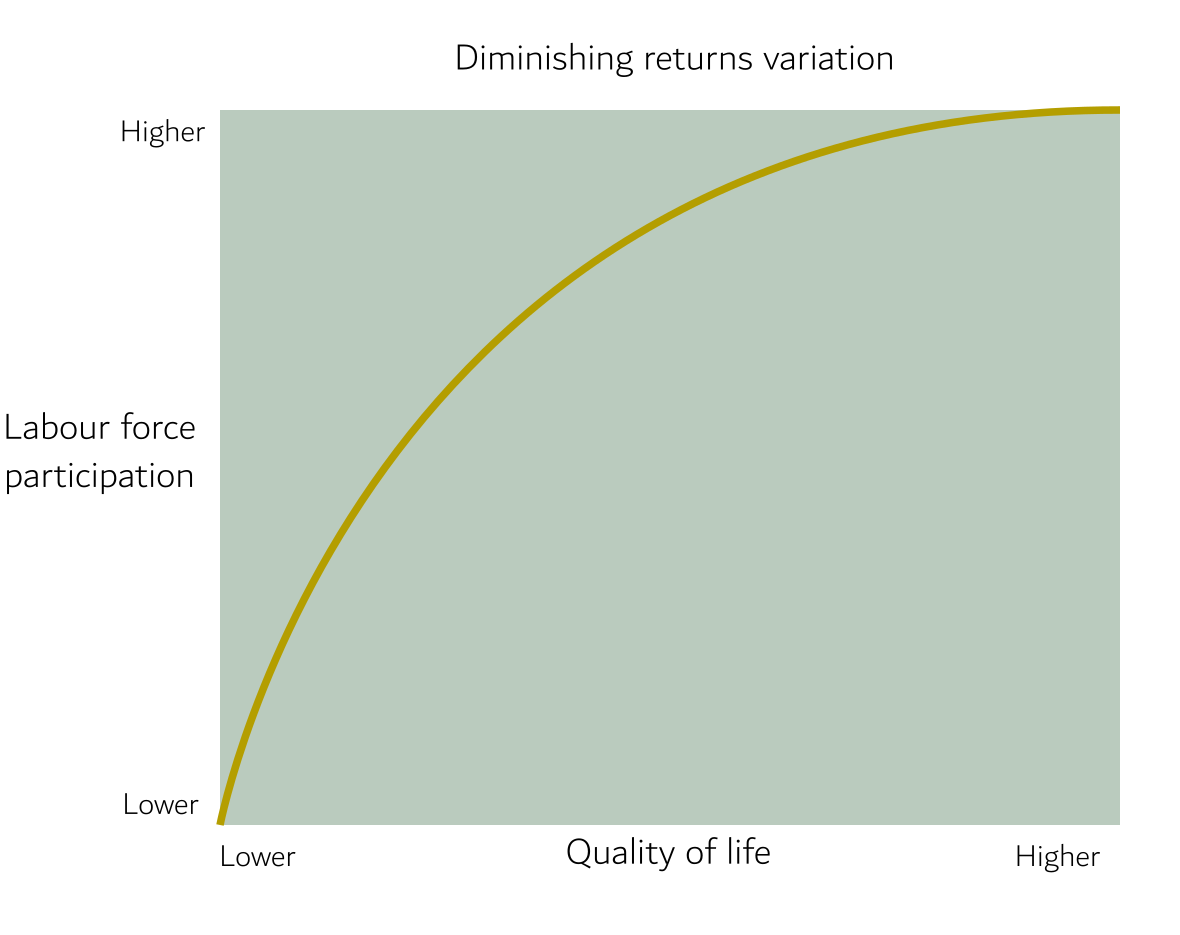
Now, I'm not suggesting that this line is precisely accurate rather than indicative - it could, for example, grow quickly and then plateau out, suggesting that each additional worker provides less benefit:
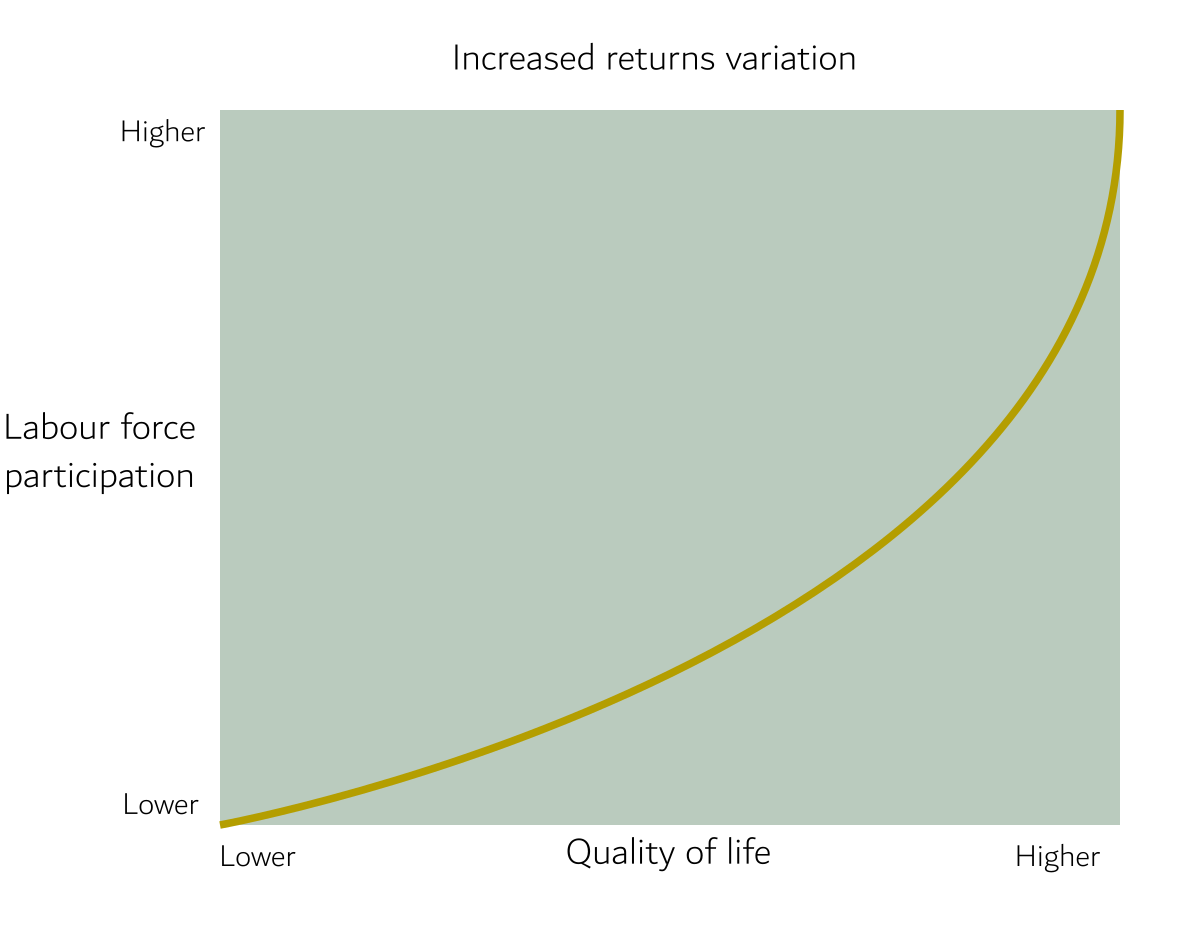
It could grow slowly and then increase suddenly, indicating that productivity is increased at scale:
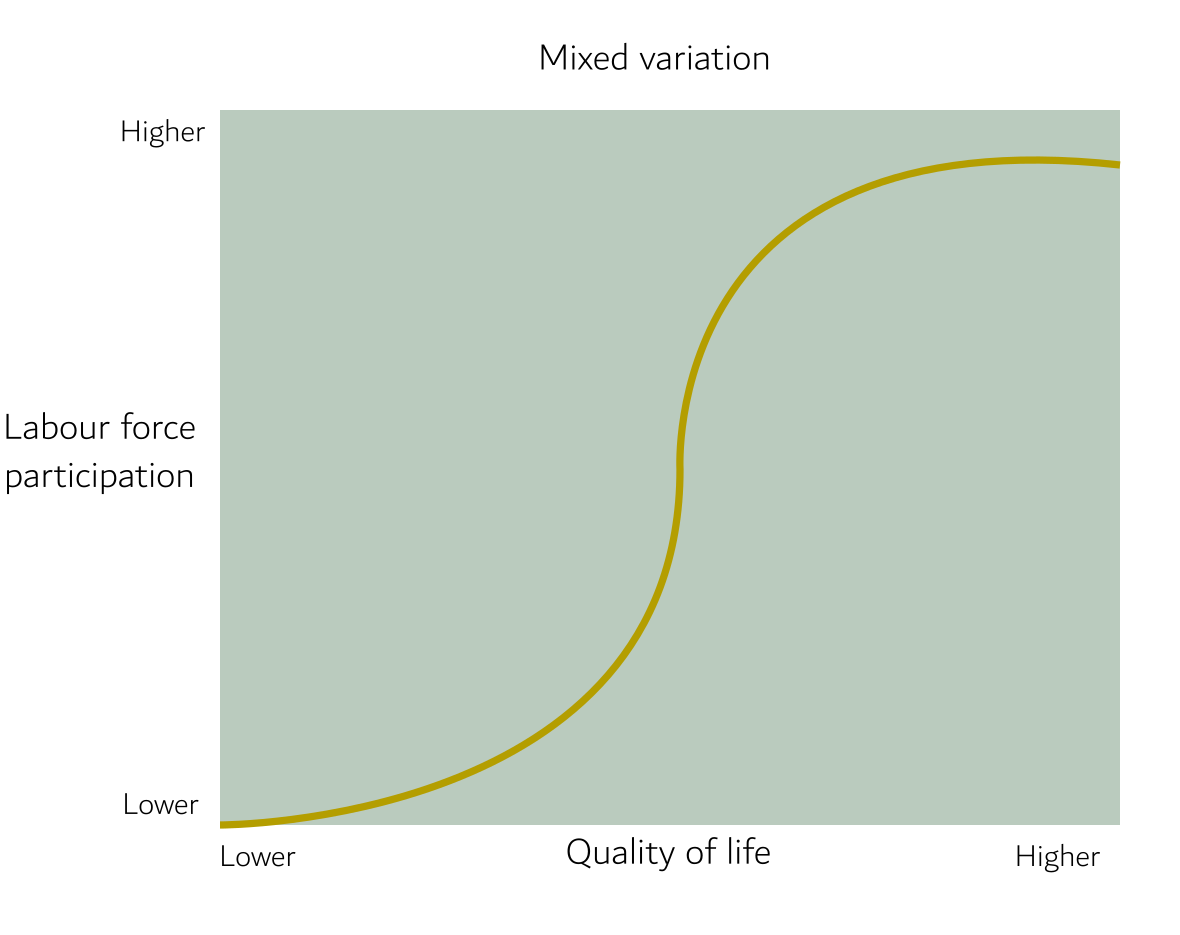
It could grow slowly, increase quickly as it hits a critical point, and then plateau out as we reach some sort of productive limit:
Empirical evidence could certainly add some detail to the core concept, but I feel somewhat safe in suggesting that there is a general relationship here.
Worker motivation and quality of life
The second idea I want to propose is that people are motivated to work when the quality of life they are experiecing does not match the quality of life that they minimally desire. That is, if conditions are insufficient for a subjectively acceptable quality of life, people will be motivated to change their conditions but putting in work of one sort or another.
Imagine, then, that each possible worker has a different acceptable quality of life, and that we could line them in order from lowest acceptable quality of life to highest acceptable quality of life. We then press "start" on society, with no quality of life yet established. In this scenario, I would imagine that practically all the workers would get to work ensuring a minimal quality of life for themselves (often by working with others). But, as the general quality of life begins to rise, some people find that their accept quality of life has been met, and they decide to stop work and simply enjoy their life instead. This person - for the purposes of this thought experiment, at least - we will consider a "free rider". As the quality of life gets higher and higher, more and more people stop being workers and start being free riders.
The indicative graph of the relationship between the percentage of workers working and the quality of life would look like this, once again a very generalised diagonal line:
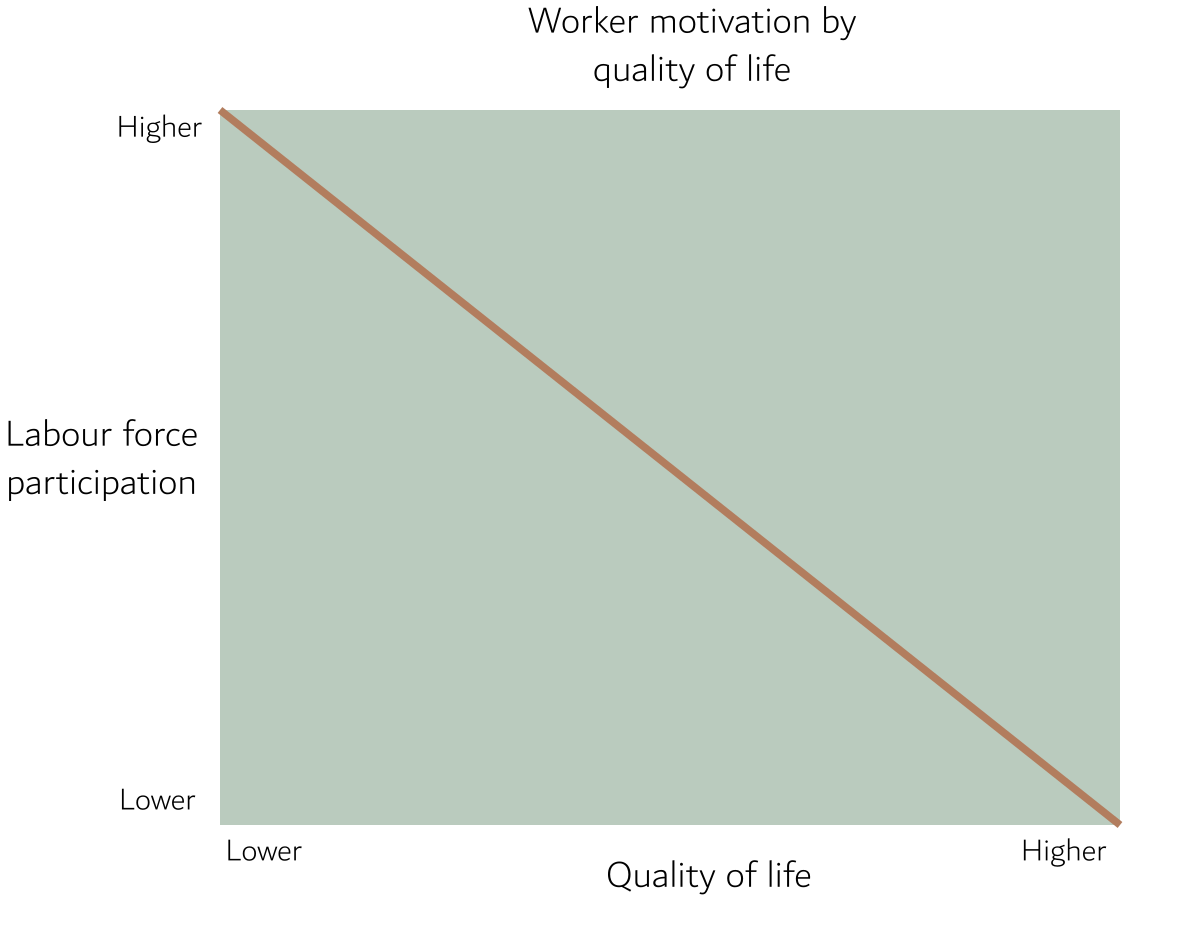
As with the other chart, there are many ways that this could be updated with empirical evidence, depending on whether workers are likely to drop out quickly or slowly, or if there are various stages of trends, but I think that the very generalised line is sufficiently indicative.
One thing to note is that there are likely people who would want to work regardless, because they find that working is part of their ideal quality of life. I'm not going to make a guess at this number just now, but it would suggest that even if AI and robots could do everything for us, we would likely still see people who have the desire to work in some meaningful capacity.
Equilibrium
These two graphs have the same axes: one for quality of life, and one for the percentage of possible workers actually working. That means that we can neatly overlay the two and look at the relationship between them:
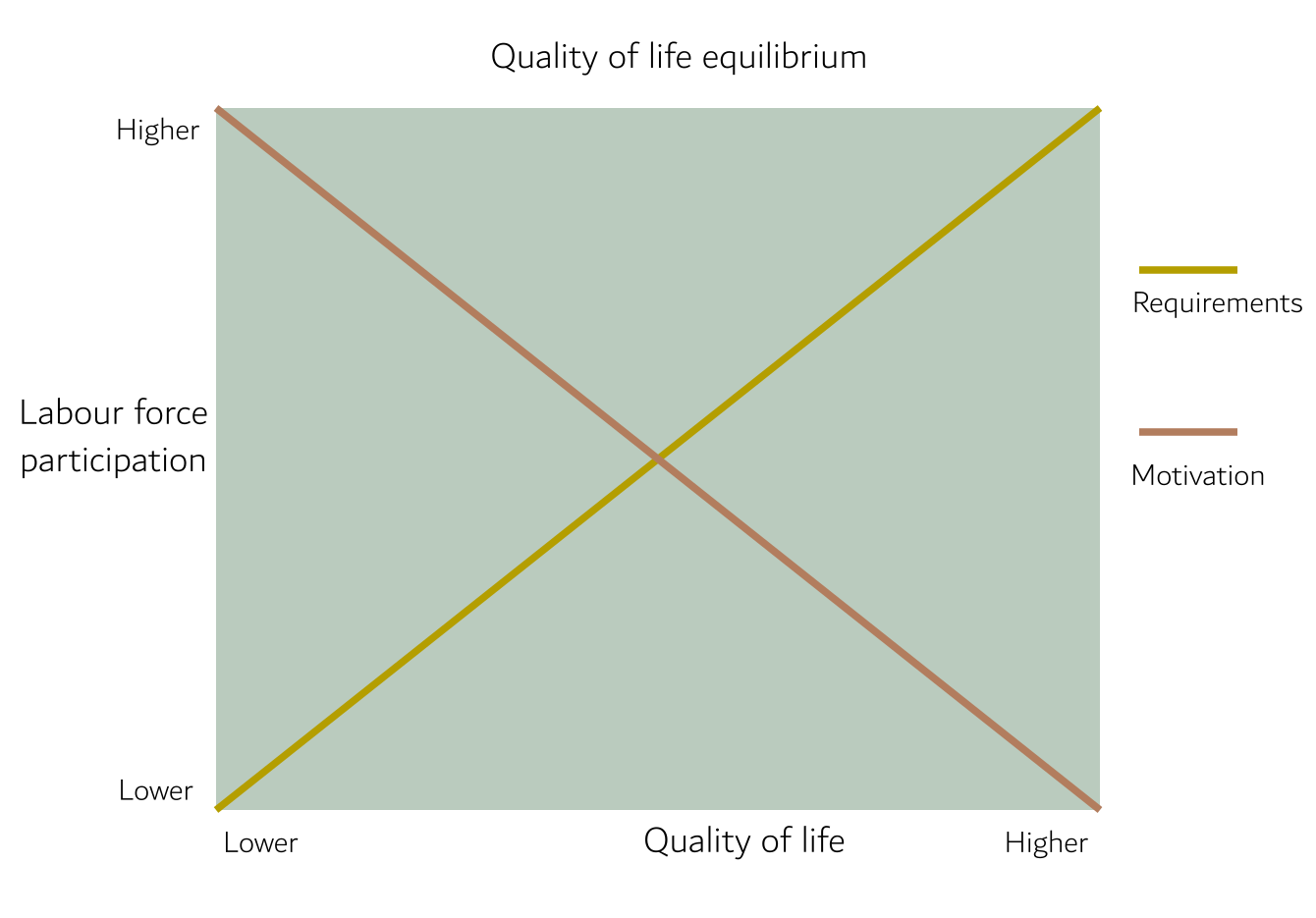
Because one line is trending up (the worker-requirement line) and one line is trending down (the worker-motivation line), regardless of the specific curves that they may follow, it is very likely that there would be an intersection between the two lines. This intersection indicates a point of equilibrium.
This represents that as more workers work, the quality of life increases, and as the quality of life increases, less workers are motivated to work, until we hit a stable point where workers are neither joining nor leaving. This point of equilibrium determines the overall quality of life that the economy will sustain.
What exactly this quality of life looks like will depend on the actual curves that the graphs follow empirically, and therefore where the real-world intersection point lines up. But the equilibrium suggests that there will always be enough people working to prevent an overall poor quality of life, and there will likely always be people working to improve the quality of life. If equilibrium is reached, that implies that most people are satisfied with their quality of life.
In fact, the graph misses something of great importance to quality of life: innovation. We can expect to see some level of innovation, especially at higher qualities of life where we might imagine there are more abundant resources, knowledge transmission and free time, and that innovation will change the relationship between the number of workers and the resultant quality of life. What we can imagine it will do is reduce the number of workers required for any particular quality of life, flattening the line.
Similarly, we could maybe expect a cultural shift among workers over time to expect a higher and higher quality of life, which would change the relationship between the number of workers motivated to work and quality of life, extending this line so that less workers drop out at each measure of quality of life. This would push the intersection point between the two relationships further and further along, so that we see improved quality of life overall but perhaps a similar percentage of workers motivated to work:
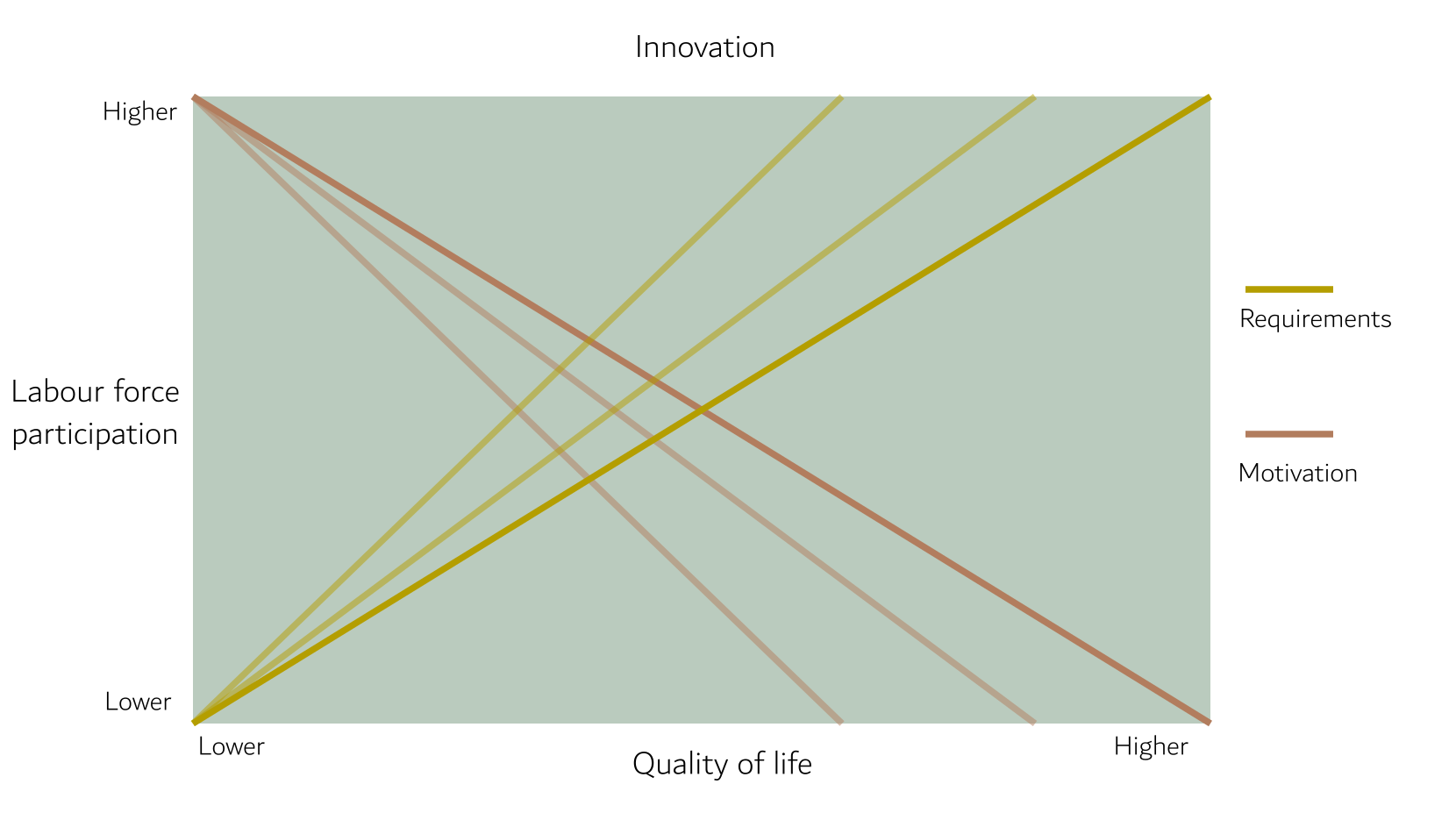
The conclusion I want to draw here is that I doubt that free riders are an issue for economic health. People are motivated to work until they can enjoy an acceptable quality of life, and this motivation, in relation to the number of workers required to reach any particular quality of life, will ensure that there are always workers, there is likely to be a largely acceptable quality of life, and people will likely be working to improve quality of life.
There are then two main questions relating to the issue of free riders in a non-reciprocal gifting economy: whether there is an issue of justice or fairness, and whether the quality of life would be lower than that in an exchange economy. I'll deal with the justice and fairness issue soon, but next I'll compare this to an exchange economy.